Why hermeticity matters for lidar
A lidar emitter module combines a high-power laser diode, a precision submount, and focusing optics in a package that must survive years of exposure to temperature cycles, humidity, vibration, and condensation. For automotive applications, that means operating from −40°C to +125°C, surviving road vibration, and resisting moisture ingress in an underhood or rooftop environment.
Non-hermetic packages — epoxy-sealed or plastic housings — fail over time as moisture permeates the enclosure, oxidizes the optical surfaces, and shifts the alignment of the optical stack. A hermetic package eliminates this failure mode by providing a metal-ceramic sealed enclosure with a leak rate low enough to maintain internal atmosphere for the product lifetime.
The relevant hermeticity standard for most lidar applications is MIL-STD-883 Method 1014, with a fine leak rate of ≤1.0×10⁻³ Pa·cm³/s. This is the same standard used in telecom and aerospace optoelectronics.
Package options for lidar emitters
Lidar emitter modules typically use one of three package formats, depending on the laser configuration and output power:
| Package type | Typical power | Configuration | Best for |
|---|---|---|---|
| TO56 / TO60 header | 1–5 W peak | Single emitter, discrete | Near-range lidar, solid-state flash lidar |
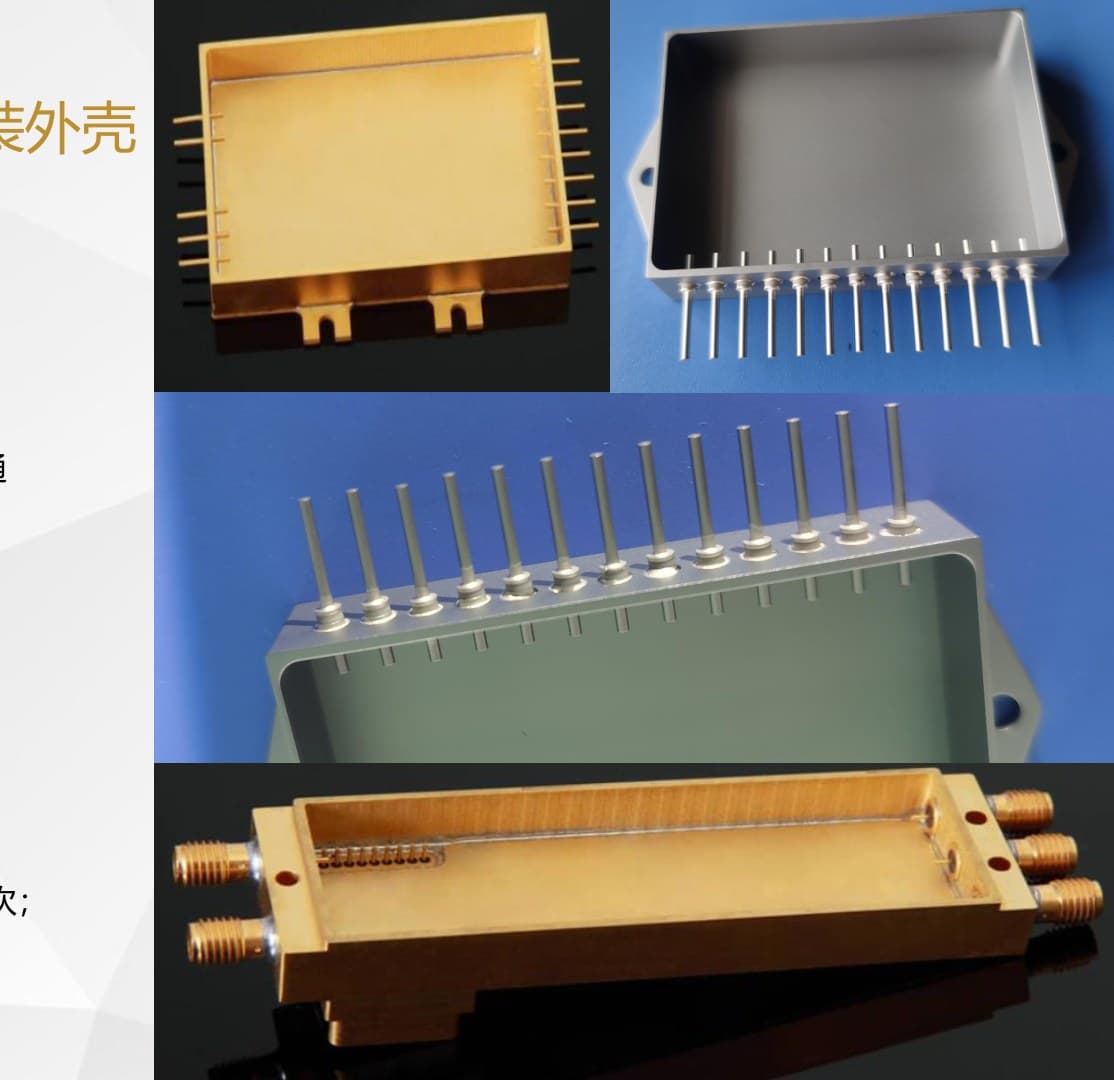
| Cavity package (single-bar) | 5–50 W peak | Single bar or array, collimated | Mid-range scanning lidar, ADAS |
| Cavity package (multi-bar) | 50–500 W peak | Stacked bar array, beam-combined | Long-range automotive, airborne lidar |
| Butterfly / TOSA | 0.1–2 W CW | Fiber-coupled, single-mode | Coherent lidar, FMCW, 1550 nm |
Thermal management: the biggest challenge
High-power lidar emitters generate significant heat in a very small area. A 100 W peak pulsed laser bar with a 1% duty cycle still dissipates 1 W average — concentrated in a die that may be 1–4 mm wide. Peak junction temperature during the pulse can be tens of degrees above the base temperature, driving wavelength shift and reducing device lifetime.
The thermal path from junction to ambient determines performance: laser die → solder bond → submount → package base → heatsink. Each interface adds thermal resistance. The submount material is the highest-leverage element you control at design time.
SiC submount — best choice for high-power lidar
- 350–400 W/m·K thermal conductivity handles multi-watt peak loads
- CTE 3.7–4.3 ppm/°C — good match for GaAs and GaN laser bars
- Available as custom cavity insert or standard submount pad
- FerraLink supplies qualified single-crystal SiC submounts with documented thermal performance
ALN submount — right for lower power
- 170–210 W/m·K — sufficient for single-emitter TO-style lidar modules
- CTE 4.3–4.6 ppm/°C — excellent match for InP-based 1550 nm devices
- Lower cost than SiC; appropriate for FMCW and coherent lidar designs
- Au/Sn predeposited for reliable die attach without solder preforms
Optical window selection for lidar wavelengths
Most automotive lidar operates at 905 nm (GaAs/AlGaAs laser bars) or 1550 nm (InP-based or fiber-amplified). Window selection must account for transmission at these wavelengths, as well as scratch resistance for field-exposed modules.
| Window material | 905 nm | 1550 nm | Scratch resistance | Notes |
|---|---|---|---|---|
| Borosilicate (AR coated) | >99% | >99% | Moderate | Standard choice, low cost |
| Sapphire (AR coated) | >98% | >98% | Excellent | Best for field-exposed or harsh-environment modules |
| Fused silica (AR coated) | >99% | >99% | Good | Low scatter, preferred for coherent lidar |
| Silicon (AR coated) | Opaque | >97% | Good | 1550 nm only; useful for compact FMCW designs |
For automotive lidar, sapphire windows are increasingly specified due to their hardness and scratch resistance. For coherent FMCW lidar at 1550 nm, fused silica with a precision AR coating minimizes back-reflection that would otherwise degrade ranging performance.
Reliability requirements for automotive lidar
Automotive lidar is an ADAS Level 2–4 safety component. Package reliability requirements are significantly more stringent than commercial datacom:
- Temperature cycling: −40°C to +125°C, ≥1000 cycles (AEC-Q100 Grade 1)
- Fine leak rate: ≤1.0×10⁻³ Pa·cm³/s per MIL-STD-883 Method 1014
- Gross leak rate: tested per Method 1014 Condition C (Freon) or equivalent
- Vibration: IEC 60068-2-6 or JEDEC equivalent for automotive environments
- Humidity: 85°C/85% RH (JEDEC JESD22-A101) or equivalent damp heat
- ESD protection: Class 1C or better per JEDEC JESD22-A114 (HBM)
FerraLink supplies hermetic cavity packages with fine leak rate test data included per shipment lot. For automotive qualification programs, production runs through IATF 16949-qualified supplier sites with PPAP-compatible documentation available on request.
Design checklist for lidar emitter packaging
Define peak power and duty cycle
Determines thermal load on submount and package. Use this to select SiC (high power) vs ALN (moderate power).
Select wavelength and window
905 nm or 1550 nm. Match window material and AR coating to wavelength and environmental requirements.
Choose package format
TO header for single discrete emitters; cavity package for bar arrays or multi-emitter configurations.
Specify hermeticity
Fine leak ≤1.0×10⁻³ Pa·cm³/s as baseline. Automotive programs may require additional gross leak testing.
Plan thermal interface
Define the submount-to-package solder interface. Au/Sn 80/20 predeposited on submount simplifies assembly and improves yield.
Qualify early with samples
Run your own thermal resistance and leak rate measurements on sample packages before committing to production quantities.
FerraLink lidar packaging components
FerraLink supplies all three layers of the lidar emitter thermal stack — SiC submounts, TO headers (TO56, TO60), and hermetic cavity packages — through qualified manufacturing partners. Parts ship with material certs, leak rate data, and full lot traceability.
Evaluation sample boxes are available so you can run thermal, leak, and assembly qualification on FerraLink parts before production release.
The part that depends on your die
The rules above hold for most edge-emitter modules. What changes from program to program is geometry, duty cycle, and how hard you are pushing junction temperature — those inputs decide material, thickness, and whether catalog samples are enough.
- Module outline, leak rate, and window transmission for your wavelength.
- TEC vs uncooled budget for your channel plan.
- Submount choice inside the full hermetic stack.
Go deeper — Package context
These guides answer adjacent questions teams ask while choosing a submount. Each ends the same way: what you can decide in general, then what needs your die and power.
- TO18, TO46, TO56, TO60: Which Laser Diode Header for Your Application?12 min · The complete TO package selection guide — transmitter vs detector cans, data-rate limits, optical wi…
- Optical Window Selection for Hermetic Laser Packages10 min · Sapphire, borosilicate, and AR-coated windows for TO and butterfly hermetic packages — wavelength, t…
- Thermal Path Design for Pulsed LiDAR Emitters: Junction to Heat Sink6 min · Pulsed 905 nm lidar emitters need heat to spread through the submount faster than the pulse duration…
More topics coming — thermal path, attach yield, qualification, and packaging context.