Start here: bandwidth, then can
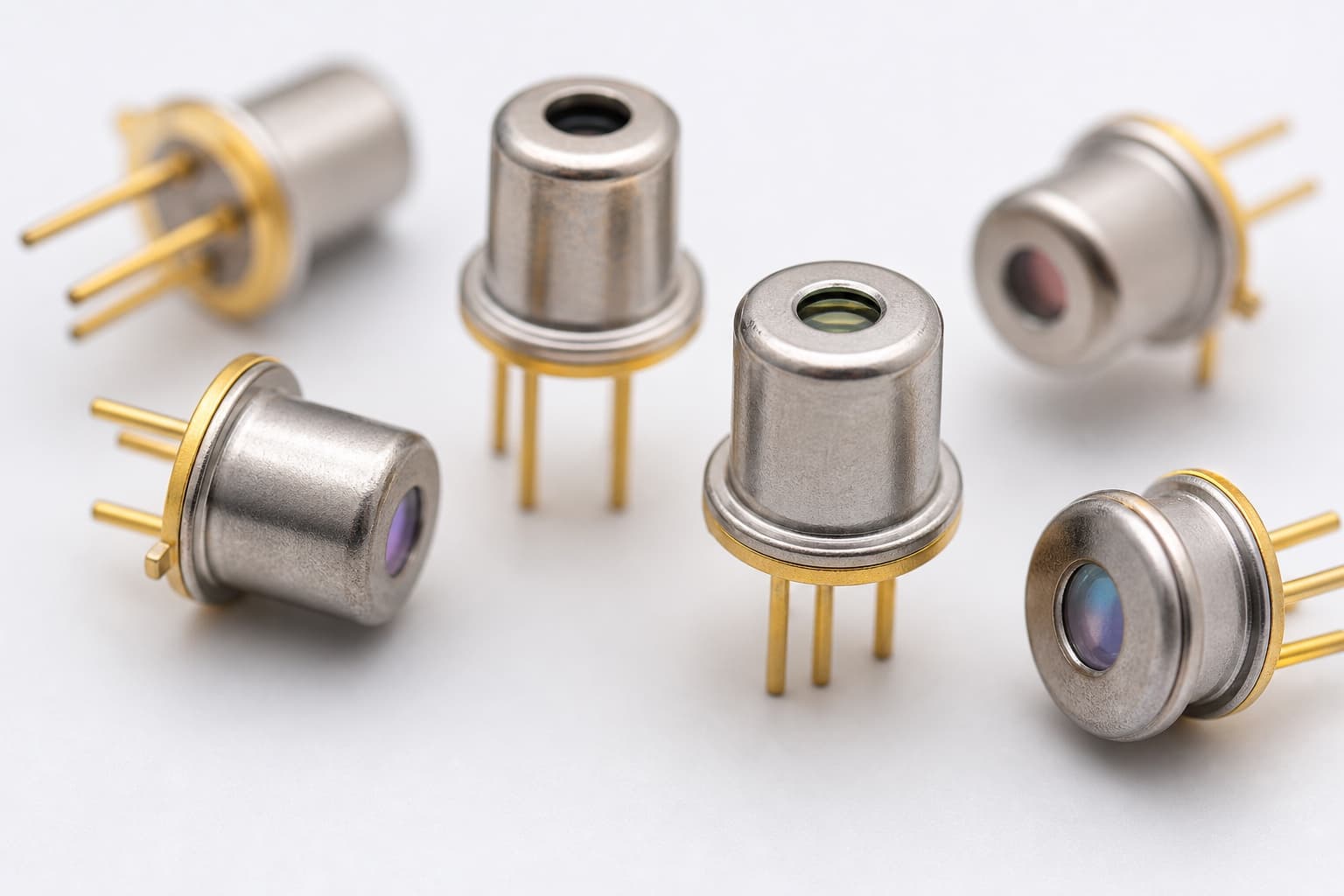
A TO (transistor outline) header is a hermetic metal can with glass-to-metal sealed leads and an optical window or lens cap. It is still the default envelope for telecom DFBs, datacom EMLs, pumps, and many industrial emitters — because the ecosystem of caps, sockets, and TOSA assembly tooling is mature.
Pick the can after you know data rate, coupling optics, and thermal budget. The wrong TO forces a board respin or a coupling redesign that costs more than the header itself. Inside the can, the laser die still sits on a ceramic submount — header choice and AlN/SiC spreading are one stack.
Companions: optical window selection · FMCW vs pulsed packaging · FMCW phase noise & Tj · AuSn attach.
Quick selection (transmitters)
- ≤ 2.5G single-mode DFB/FP, cost-sensitive → TO18 (TO46 only if space forces 4.7 mm).
- 10G SFP+, CATV return path → TO56 with MPD pin and RF layout discipline.
- 25G+ SFP28/QSFP28, EML, PAM4 → TO60 or vendor proprietary high-speed can.
- DWDM / coherent λ lock → TO56/TO60 + TEC; uncooled only if channel plan allows ± nm class drift.
- Detector or slow sensor → TO5 / TO8 / TO-39-class — not TO56/TO60.
Ready to quote a can? Browse the TO-46, TO-56, and TO-60 catalog or send a drawing through the TO header RFQ. Samples and outline quotes typically return in 2–4 weeks.
Full TO family at a glance
| Package | Base ⌀ (typ.) | Speed class | Role | Primary use |
|---|---|---|---|---|
| TO46 | 4.7 mm | ≤ ~2G | Emitter | VCSEL, ToF, compact sensing |
| TO18 | 5.6 mm | ≤ 2.5G | Emitter | DFB/FP telecom, pumps, industrial |
| TO56 | 5.6 mm | ~10G | Emitter | 10G SFP+, CATV TOSA |
| TO60 | 5.6 mm* | 25G+ | Emitter | 25G EML, coherent TOSA |
| TO5 | 9.0 mm | DC–low MHz | Detector | PIN/APD modules, sensors |
| TO8 | 12.7 mm | DC–low MHz | Detector | Large-area PD, arrays |
| TO-39† | 9.0 mm | Varies | Either | Often PD; verify hermetic spec |
*TO60 lead-frame outline is sometimes quoted as 6.0 mm by vendors — confirm mechanical drawing. †TO-39 is a common 9 mm can designation; do not confuse with non-existent "TO9."
TO18 — the workhorse
Lowest cost, widest supplier base, 2–3 pins, proven −40°C to +85°C field history. Hard ceiling near 2.5G from lead parasitics — not a path to 10G without external equalization fiction.
Standard part: FL-TO18-2G — telecom CWDM/DWDM, pumps, industrial CW.
TO-46 package — compact VCSEL and sensing
Smallest common hermetic emitter can. Strong for VCSEL arrays, proximity/ToF, and multimode short reach — weak for single-mode 10G+ because of lead inductance and aperture limits. Definition and quote path: what a TO-46 package is.
TO56 — 10G industry standard
Fourth pin for monitor photodiode (MPD), RF-aware lead routing, same 5.6 mm socket ecosystem as TO18 for mechanical tooling overlap. Requires controlled-impedance PCB — not a wire-bond-afterthought layout.
Standard part: FL-TO56-10G.
TO60 — 25G and coherent-class TOSA
Impedance-controlled transmission for 25G NRZ and advanced formats (PAM4, external modulator/coherent builds). Higher unit cost and tighter assembly yield than TO56. Many 100G lanes are four 25G optical paths — TO60 is the baseline hermetic can, though some vendors use proprietary cans above 50G aggregate.
Standard part: FL-TO60-25G.
TO5 / TO8 — detectors, not datacom lasers
Large-base cans optimized for photodiodes and sensors: wide temperature (−40°C to +100°C class), low dissipation, many pins on TO8. Using TO5/TO8 for 10G transmitters is a category error — bandwidth and RF design are not there.
“TO9” and other outlines engineers ask about
- TO9: Not a standard telecom laser designation — clarify on drawings (often TO-39 or a custom 9 mm can).
- TO-39: 9 mm hermetic can common for photodiodes and some lasers; specify leak rate, window, and pinout explicitly.
- TO-52 / TO-72: Appear in legacy and specialty modules — validate against your socket vendor, not blog shorthand.
- Butterfly / BOX: Beyond TO when you need TEC, fiber pigtail strain relief, and 40G+ coherent — not replaced by TO60 alone.
Optical window and coupling
| Window / optic | Transmission (typ.) | Best for |
|---|---|---|
| Flat glass | ~92% | Low-cost, non-critical coupling |
| Flat glass AR | > 99% at λ₀ | Telecom — specify angle |
| Sapphire flat | > 96% | Harsh env, scratch resistance |
| Ball lens cap | Focused beam | Fiber pigtail, collimation |
| Aspheric cap | High NA | Premium SMF coupling, 25G+ |
Coupling method sets tolerance: butt ~10% efficiency and ±2 µm class alignment; ball lens ~30–40%; GRIN/microlens ~55–75%; aspheric up to ~80% with cost. Full window spec depth: optical window guide.
Thermal path inside the can
TO18/TO46: junction-to-case Rth often 200–300 K/W class on copper post — fine for sub-watt CW. TO56/TO60: lower Rth with optimized lead-frame and CuW spreaders in high-power TOSA builds. At 10–25G, die dissipation plus poor submount attach raises Tj and wavelength drift — size SiC or AlN and AuSn void limits before upgrading the can alone.
Common mistakes
| Mistake | Outcome | Fix |
|---|---|---|
| TO60 for 2.5G CWDM | 3–5× BOM, RF test burden | TO18 + AR window |
| TO18 for 10G SFP+ | BER failures, heat | TO56 + RF PCB |
| TO56 for 25G PAM4 | Eye closure | TO60 or proprietary can |
| TO8 for 10G TX | Wrong category | TO56/TO60 emitter can |
| Uncooled for 100 GHz-spaced DWDM | λ drift | TEC + λ lock loop |
FerraLink supply
FerraLink supplies TO headers through qualified manufacturing partners. Glass-to-metal seal qualification data available; caps and windows per drawing. Samples from $25; 10-piece mixed TO18/TO56/TO60 evaluation box $250.
Specifying a TOSA or pump module? Expand the technical review — complete TO family pros/cons, hermetic/getter science, coupling economics, and qualification context with citations.
For experienced packaging engineers
Literature-backed TO package selection review
Peer-reviewed sources, interface data, and packaged-device literature — written by FerraLink materials engineering to support submount and attach decisions, not as neutral survey copy.
+26 minExpand literature-backed review ↓
For experienced packaging engineers
Literature-backed TO package selection review
Peer-reviewed sources, interface data, and packaged-device literature — written by FerraLink materials engineering to support submount and attach decisions, not as neutral survey copy.
FerraLink publishes this expanded review because TO header selection is the highest-traffic packaging decision on our site — and because the full TO family (emitters and detector cans) is often collapsed to four part numbers. Below: mechanical roles, optical coupling physics, thermal and hermetic reliability, and when to exit standard TO entirely.
1. Standardization and hermetic architecture
TO packages evolved from discrete transistor outlines to optoelectronic cans requiring optical apertures, fiber-alignment tolerances, and controlled internal atmosphere. IEC/JEDEC-style outlines define base diameter and lead geometry; Telcordia-class qualification adds thermal cycling, humidity bias, and accelerated aging for carrier-grade modules.
Modern headers use kovar leads with glass-to-metal seals; cap weld completes hermeticity. Getters absorb residual H₂O, H₂, and organics that otherwise degrade facet coatings and power stability[Mauri 2024]. Black-coated getter formulations reduce scattered light in high-power cans[Mauri 2024].
2. Transmitter packages — pros and cons
TO18 remains the cost and ecosystem leader for ≤2.5G: mature supply, wide pigtail tooling, acceptable Rth for sub-watt lasers[Verma 2008] [Yan 2021]. Limits: lead inductance blocks 10G+ without redesign; no integrated MPD pin on standard 3-pin configs.
TO46 trades RF performance for 4.7 mm footprint — ideal for VCSEL and sensing, not for SM 10G TOSA. TO56 adds MPD feedback and RF-aware routing for 10G SFP+ ecosystems[Komanec 2023]. TO60 targets 25G impedance-controlled paths and EML/coherent TOSA — higher cost, stricter PCB SI, and thermal margin at full modulation[Wu 2020].
3. Detector packages — TO5, TO8, TO-39
TO5 (9 mm) and TO8 (12.7 mm) prioritize environmental range and detector mechanics over bandwidth. TO-39 is a parallel 9 mm hermetic family often used for photodiodes — specify whether the drawing means TO5-style sensor cans or TO-39 pinout. None replace TO56/TO60 for datacom transmitters.
4. Optical coupling efficiency
Butt coupling (~10% theoretical best-case) demands ±2 µm class alignment; ball lens raises efficiency to ~30–40% with relaxed tolerance; GRIN rods and fiber-tip microlenses reach ~55–75%; aspheric caps target ~65–80% for premium 25G links. A 10 dB coupling margin at the transmitter can dominate datacenter power budgets — efficiency is a system-cost variable, not a lens afterthought[Wu 2020].
Window materials: borosilicate + AR for telecom volume; sapphire for abrasion and thermal shock; quartz when UV–NIR broadband matters. Laser-direct soldered optic micro-assemblies are an emerging packaging path for hybrid integration[Stenchly 2022]. Drawing detail: optical window guide.
5. Thermal management and TEC
Junction temperature sets wavelength, threshold, and reliability. Early TO18 designs used centered Cu posts (200–300 K/W class). High-power TOSA work pushes CuW spreaders and multi-path lead frames toward ~1 K/W class in advanced pump modules[King 2023] [Verma 2008].
Failure modes: Tj drift, coating damage under localized flux, wire-bond lift under thermal cycling[Yan 2021]. DWDM and coherent programs add TEC when uncooled λ drift exceeds channel plan — budget 2–3× laser electrical power for automotive-grade stabilization in harsh ambients[Verma 2008]. DWDM/coherent programs: plan TEC and λ lock in the module BOM — see FMCW thermal and optical window guides.
6. Application mapping
| Application | Typical TO | Notes |
|---|---|---|
| 2.5G CWDM/DWDM | TO18 | Cost leader; λ stability may need TEC |
| 10G Ethernet SFP+ | TO56 | RF layout + MPD required |
| 25G SFP28 / QSFP28 | TO60 | PAM4 stresses thermal + SI |
| CATV return / DTT | TO56 | Proven 10G ecosystem |
| Pump / industrial CW | TO18 | Submount Rth often first lever |
| VCSEL / ToF / auto | TO46 | Compact; multimode friendly |
| PIN receiver slow link | TO5 / TO-39 | Not TO56 |
| Coherent / FMCW TX | TO60 + TEC or butterfly | See FMCW thermal guide |
7. Reliability and qualification
Hermetic leak rate (He fine leak, <10⁻⁹ atm·cc/s class targets), humidity bias (85°C/85% RH), and thermal cycling (−40/+85°C, 100–500 cycles) gate telecom release. Wire-bond cross-section after cycling is mandatory for aerospace-tier programs. Optical degradation ties to moisture and contamination — getter and clean cap assembly are process requirements, not options[Mauri 2024].
8. Total cost of ownership
Over-specifying TO60 on a 2.5G line adds 30–50% system cost (package, PCB, RF lab). Under-specifying TO18 on 10G drives rework, equalization hacks, and field BER cost. Correct-first-time selection: TO18 ≤2.5G, TO56 at 10G, TO60 at 25G+, detector cans for receive-only paths.
9. Stack below the header — FerraLink view
The TO can is the hermetic envelope; yield and Tj are won on the submount and AuSn attach inside. Pre-deposited AuSn on DPC AlN/SiC reduces void fraction versus preforms for sub-mm padspreform vs predep void inspection. We supply headers, submounts, and evaluation kits so you qualify the full stack — not the catalog line item alone.
References
A. Verma et al. (2008). Thermal management issues in laser diode packaging. IEEE SMELEC. DOI
Y. Yan et al. (2021). Review of high-power semiconductor laser packaging. Front. Phys.. DOI
L. Mauri et al. (2024). Gaseous impurities in packaged laser diodes. IEEE LS24. DOI
M. Komanec et al. (2023). 1310 nm laser TOSA for radio-over-fiber. IEEE Access. DOI
H.-S. Wu et al. (2020). Optical transmitter module for O-band Si photonic engine. ECTC. DOI
B. King et al. (2023). High-power GaAs emitters — packaging thermal context. CLEO/Europe-EQEC. DOI
V. Stenchly & W. Reinert (2022). Opto-packaging with laser direct soldering. ESTC. DOI
FerraLink selects citations for packaging relevance; verify against your program requirements before qualification sign-off.
The part that depends on your die
The rules above hold for most edge-emitter modules. What changes from program to program is geometry, duty cycle, and how hard you are pushing junction temperature — those inputs decide material, thickness, and whether catalog samples are enough.
- Target Gbps, modulation (NRZ vs PAM4), and transceiver form factor (SFP+, butterfly).
- Coupling architecture (butt, ball lens, GRIN, aspheric) and required insertion loss.
- Submount material, AuSn attach, and whether TEC is in the module BOM.
Go deeper — Package context
These guides answer adjacent questions teams ask while choosing a submount. Each ends the same way: what you can decide in general, then what needs your die and power.
- Optical Window Selection for Hermetic Laser Packages10 min · Sapphire, borosilicate, and AR-coated windows for TO and butterfly hermetic packages — wavelength, t…
- Hermetic Packaging for LiDAR Applications7 min · Package types, thermal management, optical window selection, and reliability requirements for lidar …
- Thermal Path Design for Pulsed LiDAR Emitters: Junction to Heat Sink6 min · Pulsed 905 nm lidar emitters need heat to spread through the submount faster than the pulse duration…
More topics coming — thermal path, attach yield, qualification, and packaging context.