Where packaging cost comes from
In a typical single-mode laser module, the packaging cost breaks down roughly as follows:
TO header or hermetic package
Largest single component cost
Submount (ALN or SiC)
Often over-specified or from premium suppliers
Assembly labor (die attach, wire bond, sealing)
Fixed — hard to reduce without volume
Optical components (lens, cap, window)
Varies significantly by application
Test and qualification
Higher for hermetic and reliability-screened parts
The TO header and submount together account for 45–65% of total packaging cost for most laser module designs — which means these two components are where cost reduction has the most impact.
Why packaging BOM drifts upward
Most packaging cost growth is engineering-driven, not a single line-item surprise. These patterns show up on nearly every laser module program:
- Over-specified materials — SiC where ALN meets the thermal budget, or fully custom geometries when a catalog TO header would qualify.
- Split supply chains — submounts from one vendor, headers from another, each with its own qualification cycle, drawing revisions, and expedite risk.
- Assembly yield loss — solder preform handling, voids at the die attach, or rework after hermetic seal failure often costs more than the ceramic line item itself.
What changes with one supplier for submounts and headers
The same performance specifications — ALN thermal conductivity, glass-to-metal seal integrity, leak rate, dielectric withstanding — should be backed by qualification data and lot traceability, not by shopping on list price alone. Consolidating submounts and TO headers under one engineering partner reduces qualification overhead and shortens the path from sample to production.
| Approach | Typical lead time | Quality documentation | Engineering support |
|---|---|---|---|
| Multi-vendor (submount + header) | 4–12+ weeks | Split qual packages | Split accountability |
| Catalog distributor | Varies | Catalog-level | Limited packaging context |
| FerraLink | 2–4 weeks (samples) | ISO 9001 / IATF 16949 supplier chain | Thermal + hermetic guidance |
Three practical cost reduction steps
1. Right-size the submount material
If your application is a standard InP DFB laser diode at 200–500 mA CW, you do not need SiC. ALN at 170 W/m·K handles the thermal load and costs significantly less. Reserve SiC for multi-watt power applications where its 350–400 W/m·K thermal conductivity is genuinely needed.
2. Use predeposited Au/Sn to reduce assembly cost
Ordering submounts with predeposited Au/Sn 80/20 (3–5 µm) eliminates the need to handle solder preforms during assembly and reduces the risk of solder rollup near critical alignment edges. The per-part cost increase is small; the assembly yield improvement is significant at volume.
3. Consolidate to one supplier for submounts + headers
Many teams source submounts from one supplier and TO headers from another, managing two qualification processes, two sets of documentation, and two supplier relationships. Consolidating to a single partner that covers both reduces overhead, shortens qualification, and keeps thermal and hermetic specs aligned across the stack.
Does cost-focused packaging design compromise quality?
This is the right question to ask. The short answer is: not when you right-size materials, keep hermetic specs explicit, and work with a supplier that ships complete qualification documentation.
The manufacturing processes for ALN submounts and TO hermetic headers are well-established and globally practiced. A sputtered Ti/Pt/Au metallization on ALN with a controlled thickness specification and a certified reflow test is the same part regardless of where it is made — as long as the factory holds ISO9001, conducts incoming inspection, and provides traceable lot documentation.
FerraLink qualifies its manufacturing partners against the same quality criteria used by tier-1 optical module manufacturers. All parts ship with:
- Material certificate (substrate grade, thermal conductivity verification)
- Metallization thickness and stack specification
- Lot number and traceability
- Leak rate test data for hermetic packages (≤1.0×10⁻³ Pa·cm³/s)
- Dielectric withstanding and insulation resistance for TO headers
The fastest way to validate
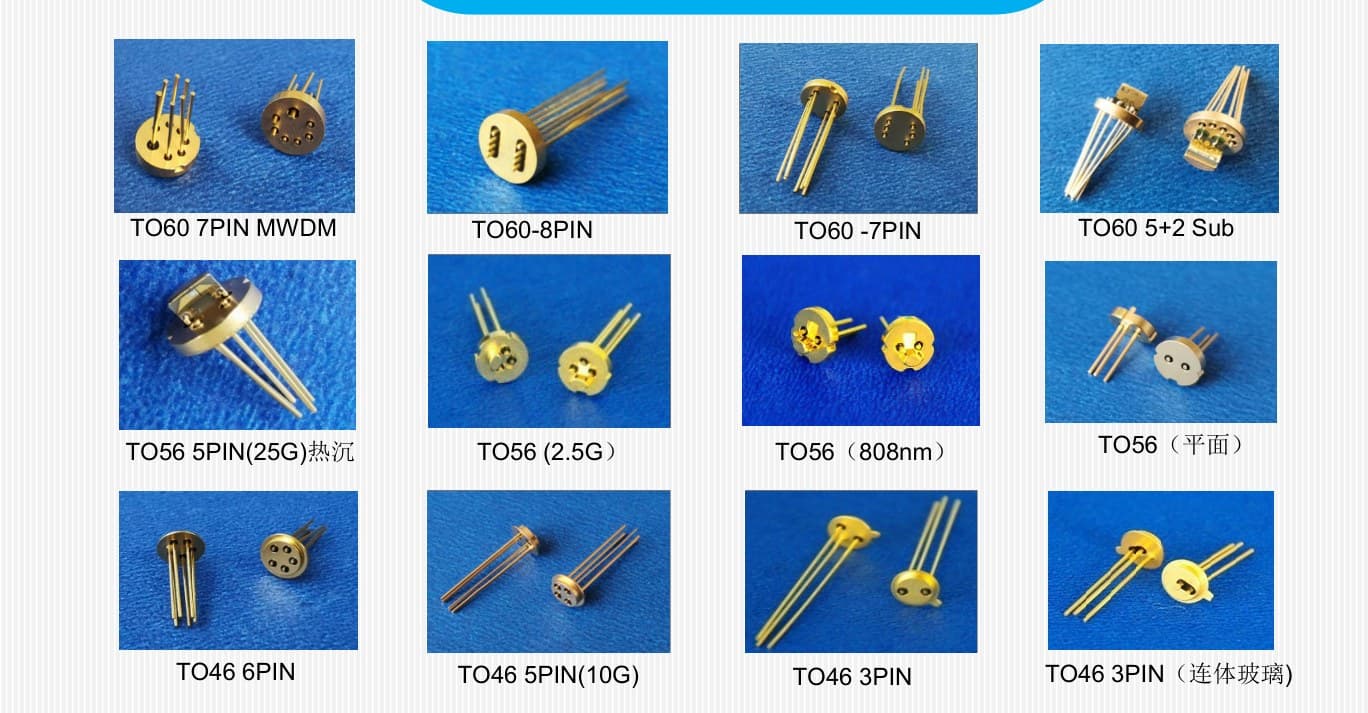
The most efficient way to evaluate a new packaging supplier is to run their parts through your own qualification process. FerraLink offers individual samples at $25/piece and a 10-piece testing box at $250 — covering ALN submounts, SiC submounts, TO18/TO56/TO60 headers, so you can run your own thermal, leak, and assembly tests before committing to production.
The part that depends on your die
The rules above hold for most edge-emitter modules. What changes from program to program is geometry, duty cycle, and how hard you are pushing junction temperature — those inputs decide material, thickness, and whether catalog samples are enough.
- Volume band, schedule, and whether catalog or custom geometry applies.
- Total cost of packaging vs die — for your SKU mix.
- Lead time risk for your build plan.