Why the 14-pin butterfly exists
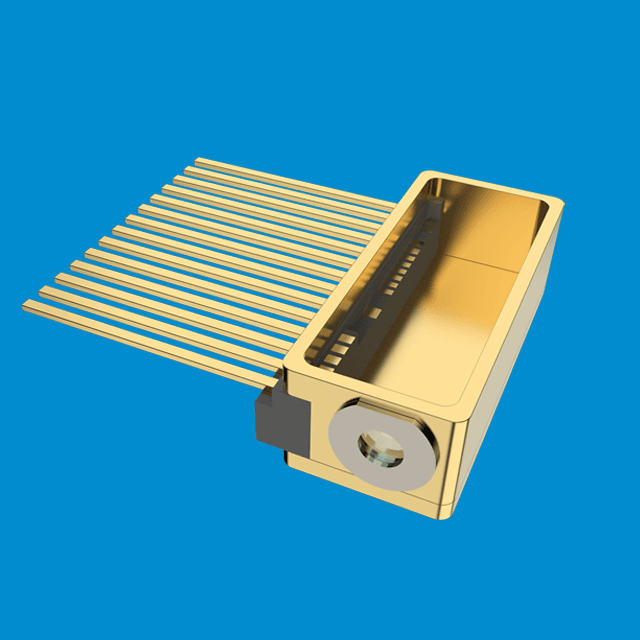
Telecom and photonics teams standardized the butterfly footprint decades ago because round TO cans could not cleanly route fiber pigtails, flex circuits, and TEC wiring for C/L-band modules. The 14-pin variant is the workhorse for DFB transmitters, external-cavity tunable lasers, and many TOSA/ROSA assemblies — enough pins for laser, monitor photodiode, thermistor, and TEC without custom feedthroughs every time.
Product page with catalog outlines and quote form:
FerraLink 14-pin butterfly
.
14-pin butterfly vs TO vs BOX
| Factor | 14-pin butterfly | TO56 / TO60 | BOX cavity |
|---|---|---|---|
| Integration | Flex + fiber pigtail | PCB socket | Hybrid bench / custom |
| TEC | Common internal pocket | Optional | Flexible floor |
| Fiber | Built-in feed-through / side window | Cap window only | Custom lid optic |
| Typical λ | C/L-band telecom, 1550 nm lidar | Pump, industrial, sensing | Bar stack, multi-die |
| Submount role | Spreader tile on floor | Small slug in stem | Large floor tile |
TO selection detail: to-header-selection-guide. Lidar hermetic context:
hermetic-packaging-for-lidar.
Application: external-cavity tunable laser
Narrow-linewidth tunable sources need stable chip temperature, isolation optics, and a fiber exit that survives field life. The 14-pin butterfly packages TEC, thermistor, and monitor paths in a footprint burn-in fixtures already understand — which is why tunable laser programs often start from a standard shell rather than inventing a new box.
Thermal stack inside the shell
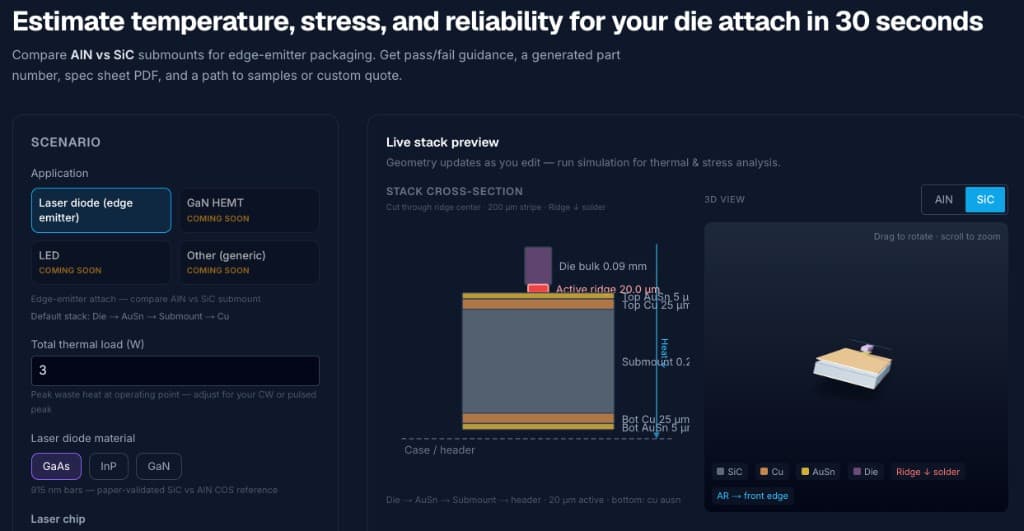
Junction temperature is set by the submount and attach under the die — not the butterfly lid alone. Telecom DFB builds frequently use AlN submounts for CTE match; higher-flux or pulsed programs may move to SiC spreading. Specify AuSn vs epoxy attach and cold-side flatness before locking pad geometry.
Material comparison: aln-vs-sic-submounts. Free drawing review:
DFM review.
What to send for a butterfly RFQ
- Operating wavelength band and window AR requirement
- Pin assignment (laser, MPD, TEC+, TEC−, thermistor)
- Fiber type (SM/PM), exit angle, and bend-radius keep-out
- Die size, submount material preference, and attach process
- Target leak rate and operating temperature range
Short quote form:
14-pin butterfly quote
or full package RFQ.
Gap
Your ERP socket, flex vendor, and fiber supplier — share the pin map and we align outline, window, and submount footprint before production quote.
The part that depends on your die
The rules above hold for most edge-emitter modules. What changes from program to program is geometry, duty cycle, and how hard you are pushing junction temperature — those inputs decide material, thickness, and whether catalog samples are enough.
- Module outline, leak rate, and window transmission for your wavelength.
- TEC vs uncooled budget for your channel plan.
- Submount choice inside the full hermetic stack.
Go deeper — Package context
These guides answer adjacent questions teams ask while choosing a submount. Each ends the same way: what you can decide in general, then what needs your die and power.
- TO18, TO46, TO56, TO60: Which Laser Diode Header for Your Application?12 min · The complete TO package selection guide — transmitter vs detector cans, data-rate limits, optical wi…
- Optical Window Selection for Hermetic Laser Packages10 min · Sapphire, borosilicate, and AR-coated windows for TO and butterfly hermetic packages — wavelength, t…
- Hermetic Packaging for LiDAR Applications7 min · Package types, thermal management, optical window selection, and reliability requirements for lidar …
- Thermal Path Design for Pulsed LiDAR Emitters: Junction to Heat Sink6 min · Pulsed 905 nm lidar emitters need heat to spread through the submount faster than the pulse duration…
More topics coming — thermal path, attach yield, qualification, and packaging context.