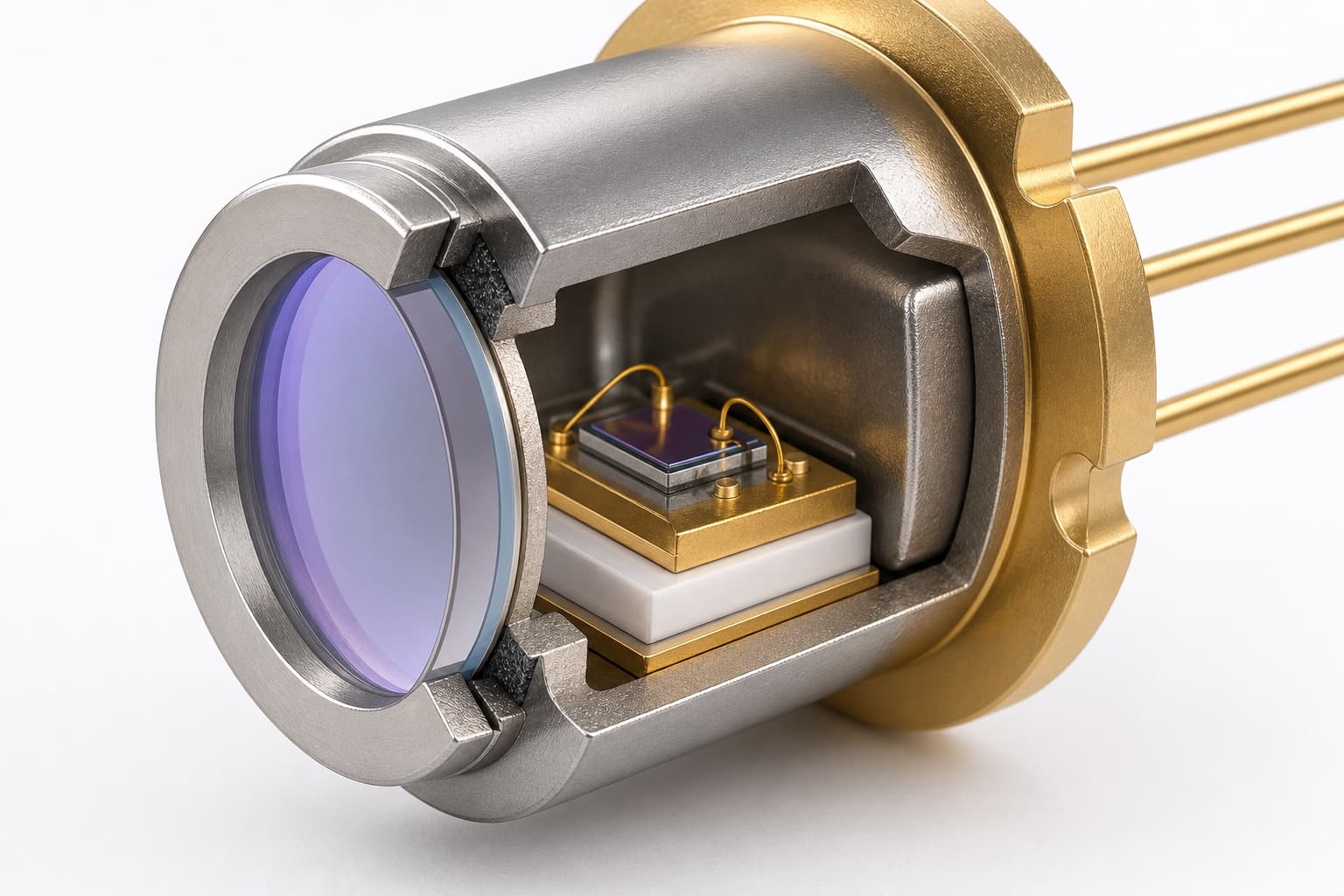
Window vs submount — different jobs
The ceramic submount spreads heat from the laser die; the optical window lets photons out while keeping moisture and contaminants in. A well-chosen SiC or ALN tile does not compensate for wrong window glass, AR band, or seal chemistry for your wavelength.
Companions: hermetic packaging for lidar · TO header selection · FMCW vs pulsed packaging · die attach void inspection.
Material starting points
| Material | λ range | Typical use | Trade-off |
|---|---|---|---|
| Sapphire (Al₂O₃) | UV – NIR | Aerospace, harsh field, UV | Cost, birefringence |
| Borosilicate | ~300 nm – 2.5 µm | Telecom TO caps, 905/1550 nm | Glass-frit friendly CTE |
| Fused silica | UV – ~3.5 µm | Low CTE, precision optics | Hygroscopic surface care |
| AR coating | At design λ | All sealed windows | Angle-sensitive in butterfly |
Environment → package class
| Class | Window / seal | Contamination control |
|---|---|---|
| Lab / bring-up | Borosilicate; adhesive sometimes OK | Pre-bake; moderate getters |
| Telecom infrastructure | Borosilicate + glass-frit | Pre-bake 200°C; passive getter |
| Aerospace / defense | Sapphire + glass-frit | NEG getter; strict leak test |
| Space | Sapphire; redundant seal | NEG + hygroscopic getter; ASTM E595 |
AR coating — what to specify
- Peak λ and bandwidth — e.g. 1550 nm center, 1 dB bandwidth ≥ 80 nm (not “broadband AR”).
- Incidence cone — butterfly fiber coupling often needs 0–20° performance; normal-incidence-only coatings fail in assembly tolerance.
- Coherent / FMCW — residual reflectance and thermal drift during sweep matter as much as average transmission.
- Leak + outgassing — MIL-STD-883 class leak rate plus ASTM E595 limits on seal materials and getters.
What you can decide here
- Sapphire vs borosilicate vs fused silica for your λ and reliability tier.
- Whether AR must be narrowband at operating λ or truly multi-band.
- Glass-frit vs AuSn ring seal vs low-temperature laser-assisted seal for your thermal budget.
What still needs your module drawing
- Acceptance angle, polarization loss, and window flatness for coupling (λ/4 at λ common).
- Hermetic leak spec and CTE match to Kovar/ceramic body.
- Internal gas (dry N₂, Ar, vacuum), pre-bake, and getter placement away from optical path.
Specifying a full module? Expand the technical review — sealing literature, contamination limits, AR angle sensitivity, and procurement checklist we use with RFQ / Stack Scoping on hermetic laser builds.
For experienced packaging engineers
Literature-backed optical window review
Peer-reviewed sources, interface data, and packaged-device literature — written by FerraLink materials engineering to support submount and attach decisions, not as neutral survey copy.
+22 minExpand literature-backed review ↓
For experienced packaging engineers
Literature-backed optical window review
Peer-reviewed sources, interface data, and packaged-device literature — written by FerraLink materials engineering to support submount and attach decisions, not as neutral survey copy.
FerraLink publishes this section for packaging and photonics engineers who must specify hermetic windows jointly with submount and header choices. We synthesize materials, AR coating, sealing, and contamination literature — framed for laser modules, not generic optics catalogs.
1. Role of the window in hermetic modules
The window is simultaneously an optical port and a hermetic barrier. Thiem et al. demonstrated fiber-coupled tapered amplifiers in hermetic 14-pin butterfly packages at multi-watt 780/850 nm output — window and seal integrity directly affect coherence and lifetime[Thiem 2023]. James et al. reported thin-film laser-assisted hermetic sealing on sapphire with leak rates below 1×10⁻¹² mbar·l/s at process temperatures under 118°C — material and seal method are coupled[James 2021].
2. Sapphire
Sapphire offers hardness, broadband UV–NIR transmission, and higher thermal conductivity than borosilicate when the window participates in heat removal. Jackson and Sova measured wavefront aberrations through laser-heated sapphire windows — nonuniform heating induces measurable optical path difference, relevant for high-power free-space outputs[Jackson 2023]. Birefringence (~0.008 index difference) matters for polarization-diverse links; align crystal orientation to polarization for fixed-wavelength systems[Shi 2024].
Chiba et al. used sapphire caps in DUV LED packages with laser glass-frit bonding, achieving high relative output at 266 nm — short-λ systems often require sapphire because borosilicate absorption rises in UV[Chiba 2021]. Franken et al. demonstrated UV-transparent extended-cavity violet lasers near 380 nm using aluminum-oxide-class materials[Franken 2025].
3. Borosilicate and fused silica
Borosilicate (Pyrex-class) matches silicon/Kovar CTE reasonably (~3.3 ppm/K) and supports mature glass-frit sealing for telecom windows[Krishna 2025]. Sandner et al. achieved wafer-level vacuum packages with glass-frit at 430–440°C, pressure ≤ 0.15 Pa and long-term stability for NIR FT spectrometer MEMS — reference class for frit process control[Sandner 2020]. Tang et al. studied quartz windows for ultra-high vacuum — borosilicate absorption climbs above ~2.5 µm, limiting MWIR use[Tang 2025].
4. Anti-reflective coatings
Specify AR at peak operating wavelength with bandwidth and angle performance. Yang et al. reported gradient-index alumina nanograss films with reflectance under 1% across 400–2500 nm on sapphire and fused silica — ultra-broadband is achievable but adds process complexity and contamination surface area[Yang 2026]. Mitsa et al. modeled how interface inhomogeneity shifts filter spectra — AR designed for normal incidence can show large reflection swings at oblique incidence, critical for butterfly packages[Mitsa 2025].
Sood et al. reviewed nanostructured AR for IR detectors with improved omnidirectional performance vs quarter-wave stacks[Sood 2023]. Doğan and Erdoğan optimized MWIR AR on CaF₂ with simulation-to-experiment agreement within 0.26% — precision narrowband design methodology applicable to fixed-λ laser windows[Doğan 2025].
5. Sealing: glass-frit, AuSn, low-T laser seal
Glass-frit remains the industrial default. Rui et al. linked frit paste leveling and saddle height to water vapor transmission — uneven frit raises WVTR and long-term moisture ingress[Rui 2018]. Roshanghias et al. demonstrated glass-frit jetting for wafer-level hermetic packaging with void-free bonds on 3D topographies[Roshanghias 2022].
AuSn solder ring seals offer lower peak temperature than some frit cycles. Zhao et al. analyzed microcavity morphology in AuSn ring seals — distributed micro-voids in the solder affect long-term hermeticity[Zhao 2019]. Marinis and Soucy modeled wafer-level solder seal geometry versus warpage[Marinis 2023]. FerraLink pre-deposited AuSn on submounts targets void-free die attach; window ring seals are a separate process but share the same qualification mindset.
6. Contamination and getters
Corazza et al. reviewed strategies to limit H₂, H₂O, VOCs, CO, and CO₂ in sealed optoelectronics — moisture at 20–30% internal level can drive electrical opens at 150°C within hours in some metallization stacks[Corazza 2025]. Pre-bake (~200°C, ~1 h) before final seal and NEG getters are standard for high-reliability modules; place getters out of the optical path to avoid scatter from activation products. Bosseboeuf et al. analyzed getter activation and sorption in hybrid wafer-level vacuum packaging — environment during processing accelerates getter saturation[Bosseboeuf 2019].
Wilde’s 30-year packaging review traces the shift from metal/ceramic hermetic to thin-film caps and the parallel rise of getter technology — optical packages follow the same pattern[Wilde 2018]. Qualify suppliers with ASTM E595 outgassing and post-stress helium leak plus transmission monitoring.
7. Package architecture: TO vs butterfly
TO caps often use borosilicate with frit to Kovar stem. Butterfly modules couple fiber at 10–30° off normal — AR must be validated over cone angle[Mitsa 2025]. Pan et al. reported fiber-grating-stabilized lasers in hermetic butterfly packages[Pan 1996]. Faugeron et al. documented space-qualified 1.55 µm DFB modules in butterfly outline — window and TEC stability interact for wavelength lock[Faugeron 2019]. Wang et al. achieved temperature-insensitive cryogenic packaging for thin-film lithium niobate with stable fiber coupling across 295 K to 1.5 K — extreme flatness and CTE matching requirements[Wang 2025].
8. Wavelength bands
| Band | Window direction | AR note |
|---|---|---|
| 905 nm pulsed ToF | Borosilicate or sapphire | Narrowband AR at 905 nm |
| 1310 / 1550 nm telecom | Borosilicate typical | Specify cone angle for butterfly |
| 1550 nm FMCW | Borosilicate or sapphire + TEC | Low T_j drift during chirp |
| UV / violet | Sapphire | Avoid organics in AR under UV flux |
Liu et al. and Zhang et al. report FMCW laser architectures where thermal chirp during modulation corrupts range accuracy — window uniformity and package thermal mass are part of the optical spec[Liu 2025] [Zhang 2026].
9. Procurement checklist (module RFQ)
- Optical: peak λ, T%, acceptance angle, polarization loss, surface figure.
- Material: sapphire / borosilicate / fused silica + thickness.
- AR: center λ, bandwidth, R(θ), environmental durability.
- Hermetic: seal type, leak rate (e.g. MIL-STD-883), CTE match, pre-bake, getters, internal atmosphere.
- Qual: thermal cycle + humidity + helium leak + transmission drift.
10. How FerraLink applies this
We supply ceramic submounts and attach metallization inside the cavity — not the window itself — but module reliability fails when window, submount, and seal are specified independently. Typical engagement: confirm λ and reliability class → match ALN/SiC submount to thermal path → align customer header/window RFQ with contamination tier → evaluation samples before production seal freeze.
References
H. Thiem et al. (2023). Fiber-coupled tapered amplifier in hermetic 14-pin butterfly package. CLEO/Europe-EQEC. DOI
R. J. James et al. (2021). Low-temperature hermetically sealed optically transparent miniature packages. ECTC. DOI
S. A. Jackson & R. M. Sova (2023). Aberrations through optical windows with nonuniform laser heating. Appl. Opt.. DOI
W. Shi et al. (2024). Transmission characteristics of high-power laser output window seal assembly. SPIE. DOI
H. Chiba et al. (2021). DUV-LED packaging with laser-glass-frit-bonded glass cap. Transducers. DOI
C. A. A. Franken et al. (2025). Tunable violet lasers with UV-transparent materials. Nat. Commun.. DOI
T. Sandner et al. (2020). Wafer-level vacuum-packaged MEMS for NIR-FT spectrometers. Micromachines. DOI
Y. Yang et al. (2026). GRIN antireflection coatings visible to MWIR via refractive index control. Opt. Express. DOI
O. Mitsa et al. (2025). Interface inhomogeneities in optical filter spectral characteristics. IEEE SIST. DOI
A. Sood et al. (2023). Nanostructured AR coatings for IR detectors. Defense + Commercial Sensing. DOI
A. Corazza et al. (2025). Strategies to prevent gaseous contaminants in sealed optoelectronics. IMAPSource. DOI
R. Tian et al. (2018). Glass frit paste levelling and encapsulation. ICEPT. DOI
H. Zhao et al. (2019). Microcavity morphology in AuSn solder ring seal. ICEPT. DOI
T. F. Marinis & J. W. Soucy (2023). Design of wafer level solder seals. IMAPSource. DOI
A. Bosseboeuf et al. (2019). Getter alloys for hybrid wafer-level vacuum packaging. Sensors Mater.. DOI
A. Roshanghias et al. (2022). Glass frit jetting for wafer-level hermetic packaging. Materials. DOI
Y. Wang et al. (2025). Cryogenic packaging for thin-film lithium niobate photonic chips. Photonics. DOI
C. Liu et al. (2025). Hybrid laser for FMCW ranging. Laser Photonics Rev.. DOI
R. Zhang et al. (2026). FMCW laser via sideband injection locking for LiDAR. IEEE LPT. DOI
FerraLink selects citations for packaging relevance; verify against your program requirements before qualification sign-off.
The part that depends on your die
The rules above hold for most edge-emitter modules. What changes from program to program is geometry, duty cycle, and how hard you are pushing junction temperature — those inputs decide material, thickness, and whether catalog samples are enough.
- Peak λ, NA / acceptance cone, and polarization sensitivity for your coupling optics.
- Hermetic leak rate target and sealing process (glass-frit vs AuSn ring).
- Internal atmosphere, pre-bake, and getter plan tied to your reliability class.
Go deeper — Package context
These guides answer adjacent questions teams ask while choosing a submount. Each ends the same way: what you can decide in general, then what needs your die and power.
- TO18, TO46, TO56, TO60: Which Laser Diode Header for Your Application?12 min · The complete TO package selection guide — transmitter vs detector cans, data-rate limits, optical wi…
- Hermetic Packaging for LiDAR Applications7 min · Package types, thermal management, optical window selection, and reliability requirements for lidar …
- Thermal Path Design for Pulsed LiDAR Emitters: Junction to Heat Sink6 min · Pulsed 905 nm lidar emitters need heat to spread through the submount faster than the pulse duration…
More topics coming — thermal path, attach yield, qualification, and packaging context.