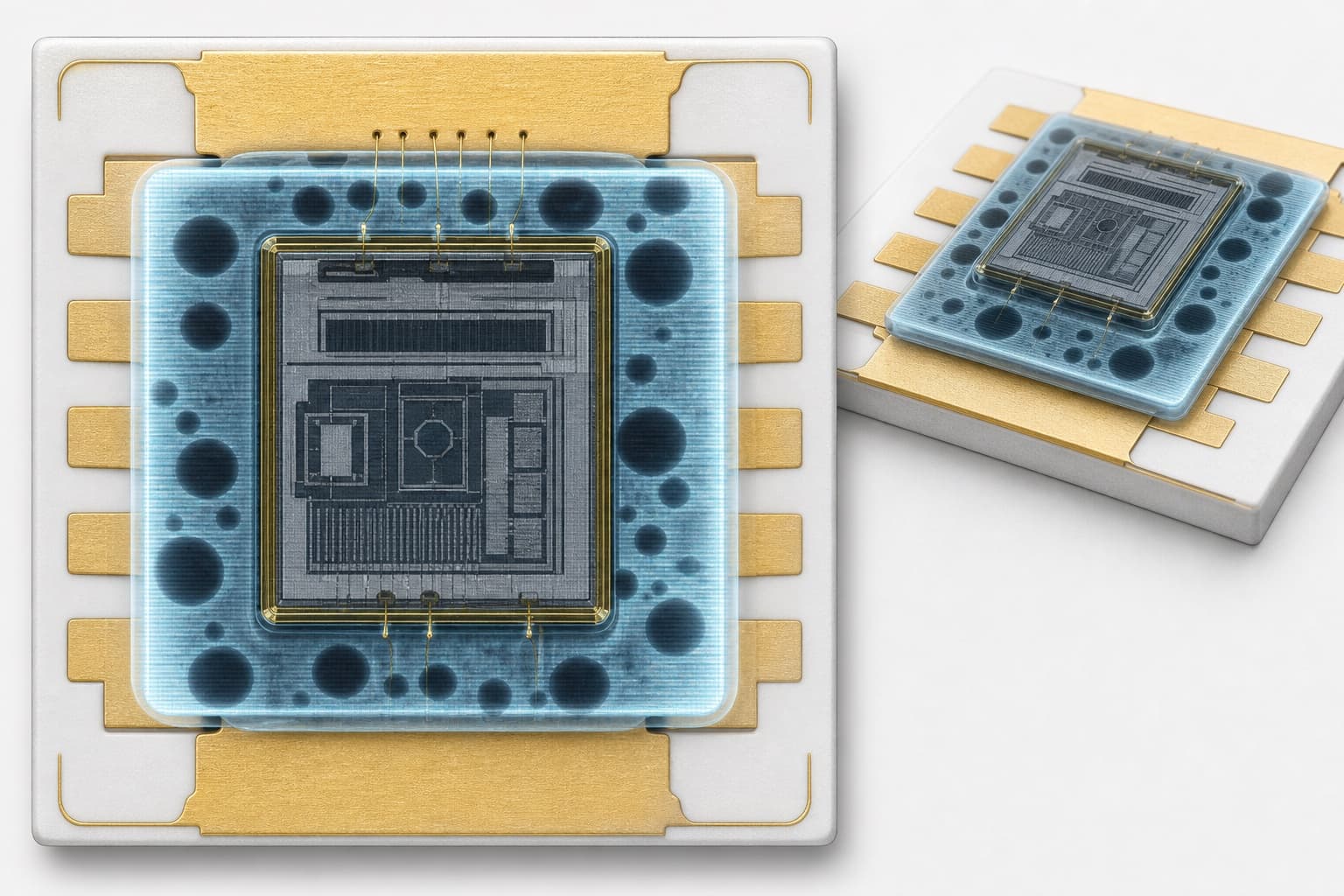
Why voids matter for lasers
AuSn 80/20 (~280°C eutectic) is the default high-temperature attach for hermetic laser modules — telecom DFBs, pumps, and industrial emitters. Voids in the bondline are not cosmetic: they block heat from the junction to the submount and create local hot spots. A void over the active ridge can raise Tj by several °C — enough to shift DFB wavelength, reduce slope efficiency, or fail aging.
X-ray after reflow is the standard non-destructive check. The goal is not zero voids on every unit; it is a defensible limit linked to thermal margin and product spec. Companion: AuSn pre-deposited submounts · CW thermal path.
Acceptance bands (starting points)
| Program type | Total void area | Single void limit | Notes |
|---|---|---|---|
| Telecom / DWDM DFB | < 2% | None over stripe | Wavelength stability driven |
| Datacom / industrial CW | 2–5% | < 10% of pad | Document reflow + material lot |
| Prototype / engineering | 5–10% | Engineering review | Tighten before production release |
| Preform, manual place | 5–15% common | Higher rework/scrap | Motivation for pre-deposited AuSn |
Void distribution matters as much as total area — a single void under the stripe dominates a peripheral void of the same size. Lock limits in your incoming and attach qualification checklist.
X-ray inspection checklist
- Views: Minimum two angles (0° and 30–45° oblique) so voids are not hidden behind die metallization.
- Resolution: Resolve voids ≥ 50 µm on sub-mm pads; smaller pads need higher magnification and tighter acquisition protocol.
- Analysis: Automated void % improves repeatability; manual review for stripe coverage on edge emitters.
- Golden units: Keep known-good and known-bad references per reflow recipe or submount lot change.
- Traceability: Tie X-ray result to submount lot, reflow profile ID, and pick-place program revision.
Root causes → process levers
| Observation | Likely cause | Lever |
|---|---|---|
| Edge voids / rollover | Excess solder, poor wetting | Pre-deposited thickness control; N₂ reflow |
| Center void | Flux entrapment, contamination | Pad cleanliness; shorter soak |
| Random high void % | Preform oxidation, aged reel | Pre-deposited submount; lot freshness |
| Die tilt after reflow | Asymmetric voids, placement | Pick-place force during peak; bondline target |
Vacuum-assisted reflow and N₂ atmosphere during peak hold are common levers when void % must stay below 3% in high-volume lines. FerraLink ships pre-deposited AuSn on DPC AlN/SiC so your line skips preform placement variance — benchmark on evaluation samples before production PO.
Rework vs release
Rework of AuSn on ceramic is costly and risks pad damage or delamination. Most lines scrap high-void units during prototype, then tighten process before scale-up. For aerospace and medical programs, scrapping marginal parts is often mandated over rework when secondary defect risk is unacceptable.
Economic break-even depends on yield recovery probability and labor — but for wavelength-locked lasers, one escaped high-void unit can cost more than scrapping an entire evaluation lot.
What you can decide here
- Which void band matches your application class (telecom vs prototype).
- Minimum X-ray views and golden-unit discipline for your line.
- When pre-deposited AuSn vs preforms is worth the material switch for void yield.
What still needs your numbers
- Correlation of void map to measured Tj or wavelength on your die size.
- Customer or internal spec (IPC/JEDEC flow, MIL-STD attach tests) that sets pass/fail.
- Reflow DOE results on your equipment with predep thickness and force schedule frozen.
Already running X-ray on every lot? Expand the technical review below — void formation physics, interface thermal R, reliability standards, and inspection literature we use when setting predep void budgets with customers.
For experienced packaging engineers
Literature-backed void inspection review
Peer-reviewed sources, interface data, and packaged-device literature — written by FerraLink materials engineering to support submount and attach decisions, not as neutral survey copy.
+22 minExpand literature-backed review ↓
For experienced packaging engineers
Literature-backed void inspection review
Peer-reviewed sources, interface data, and packaged-device literature — written by FerraLink materials engineering to support submount and attach decisions, not as neutral survey copy.
FerraLink publishes this section for attach and reliability engineers who need sourced context beyond acceptance tables. We focus on AuSn laser die attach on ceramic submounts — how voids form, how they modulate thermal resistance, what X-ray and complementary methods show, and how qualification standards treat first-level interconnect defects.
1. Historical context: AuSn in laser packaging
Eutectic AuSn 80/20 replaced lead-bearing solders in high-reliability optoelectronics decades ago — melting near 280°C, compatible with gold metallization, and stable under the creep and fatigue loads seen in telecom, industrial, and aerospace laser modules. X-ray inspection became routine as pad sizes shrank and void sensitivity to Tj was documented in high-power diode packages.
The industry converged on bounded void acceptance rather than zero-defect mandates: perfect bondlines are not achievable at volume, but limits must trace to thermal and spectral margins for the product class.
2. Void formation mechanisms
Voiding is an active thermomechanical process, not random porosity. Primary drivers on AuSn attach include:
- Flux entrapment and outgassing — volatile flux decomposition during peak reflow traps gas in the molten pool.
- Thermal gradients during reflow — asymmetric heating on ceramic submounts creates pressure gradients that nucleate and coalesce voids toward cooler regions.
- Surface oxidation and preform age — oxidized or humidity-exposed preforms show elevated void ratios vs fresh pre-deposited metallization.
- Bondline geometry — excess solder thickness and die tilt promote edge rollover and trapped volumes.
Vacuum reflow during peak, N₂ atmosphere, and controlled pre-deposited thickness are the levers production lines use when cumulative void must stay below ~3% with largest single void under ~0.4% of pad area in optimized builds.
3. Thermal transport and Tj relationship
Voids are low-conductivity inclusions in a path that must move heat from the junction to the submount. Deng et al. measured interface contact thermal resistance in high-power laser diode packages — chip–solder R ≈ 0.38 K/W and solder–sink R ≈ 0.36 K/W[Deng 2024]. Void fraction and position directly inflate those interface terms; they are not separable from bulk submount k in a qualified stack.
Physics summary for laser programs:
- Conductivity degradation — voids interrupt continuous heat flow; ~10% void over the ridge can add several °C at the junction in CW DFB modules.
- Spreading resistance — void area and location scale nonlinearly; under-stripe voids can increase effective spreading R by 2–5× vs peripheral voids of equal area.
- Current crowding — RF and pump lasers concentrate current near void edges, accelerating localized heating and electromigration stress.
For DWDM, even 1–2°C shifts move wavelength enough to matter for channel plan and APC loop stability — void limits are spectral specs as much as attach specs.
4. X-ray practice and automated void metrology
2D X-ray at multiple angles remains the production workhorse for non-destructive void detection after reflow[Maur 2005] [He 2007]. High-resolution systems with oblique views resolve wetting and void position on sub-mm pads; nanofocus sources extend sensitivity for small features.
Cui et al. demonstrated K-means clustering on X-ray images — gray value, eccentricity, and area as features — for automated void ratio on diverse joint geometries including power devices[Cui 2022]. Bernard reviewed 2D, laminography, and CT advances for void and interfacial analysis in electronics assemblies[Bernard 2018]. Bastin and Krastev documented 2D/3D CT X-ray for QFN void percentage and co-planarity control in volume assembly[Bastin 2011].
| Method | Strength | Typical use in attach QA |
|---|---|---|
| 2D X-ray (multi-angle) | Fast, line-ready | 100% or sampling on reflow exit |
| Laminography / 2.5D | Better Z discrimination | NPI, disputed 2D reads |
| 3D XCT | Full bondline volume | Root-cause, golden unit archive |
| SAM | Interface delamination + voids | Reliability lots, aging studies |
5. Reliability standards and regulatory context
Die-attach qualification pulls from multiple bodies — JEDEC and AEC for power cycling and lifetime methodology, IEC for environmental classes, and IPC for board-level and assembly stress protocols. IPC-9701B defines accelerated thermal cycling with controlled ramp rates (e.g. max 20°C/min) to avoid thermal-shock artifacts unrelated to low-cycle fatigue of the joint.
Common qualification profiles include −40°C to +125°C with 15–30 minute dwells; aerospace and automotive programs often widen to −55°C to +150°C or beyond. MIL-STD-883 die shear (Method 2019) and related wire-bond tests remain reference points for first-level interconnect strength on hermetic laser builds.
Lim et al. simulated and tested void effects in first-level interconnects — voids drive current crowding and accelerate electromigration; packages with voids underperformed in thermal cycling, electromigration, and thermal shock vs void-minimized controls[Lim 2022]. Schmid et al. combined scanning acoustic microscopy with transient thermal analysis to track void and crack evolution in high-power LED interconnects — relevant methodology for aging studies on solder joints[Schmid 2022].
Obeng et al. linked 4D XCT metrology to thermal-fatigue damage in solder joints under operational stress — supporting use of 3D imaging when field returns show “no fault found” but impedance or thermal drift is present[Obeng 2024].
6. Scale-up: prototype → production void budgets
| Phase | Typical void band | Inspection discipline |
|---|---|---|
| Prototype / DOE | 5–10% | Sample X-ray; map reflow levers |
| Pilot (100s–1000s) | 2–5% | 100% X-ray; SPC on void % mean/range |
| Production release | < 2% (telecom class) | Golden units; lot traceability; predep lot lock |
Joshi et al. reported formic-acid reduction reflow solder pastes achieving consistent void ratio below 2% with controlled flux chemistry — illustrative of how material and atmosphere co-optimization tightens spec without sacrificing throughput[Joshi 2025]. Laser hermetic lines on ceramic more often optimize pre-deposited AuSn and N₂/vacuum reflow than switch paste systems; the principle — control outgassing at source — is the same.
7. Application-specific notes
DFB / DWDM: Tightest void budgets; stripe coverage and Tj correlation to wavelength lock. Deng et al. tie packaged laser reliability directly to attach quality and interface contact area[Deng 2024].
Pumps and bars: Higher flux — void location and current crowding dominate; asymmetric void patterns can produce 2–3× local hotspot factor vs uniform heating.
RF / GaN: First-level void maps interact with ground path and shear qualification; see also GaN submount selection for spreading context.
8. How FerraLink applies this
- Ship pre-deposited AuSn on catalog AlN/SiC with thickness and composition controlled at source — reducing preform oxidation and placement variance.
- Support evaluation lots with lot documentation for incoming X-ray baseline before volume PO.
- When void % fails spec, review reflow profile + submount lot together — not die placement alone.
- Escalate to Stack Scoping or Focused Analysis when void acceptance must be tied to modeled Tj for a frozen module drawing.
The objective is not a universal void % — it is a limit your team can defend in qualification and audit, backed by thermal margin on the product you ship.
References
L. Deng et al. (2024). Interface contact thermal resistance of die attach in high-power laser diode packages. Electronics. DOI
C. Cui et al. (2022). K-means algorithm for void ratio of solder joints from X-ray images. ICEPT. DOI
D. Bernard (2018). 2D and 3D (CT) X-ray inspection advances for void analysis in electronics. Soldering & Reliability Conf. DOI
F. W. Maur (2005). Lead-free solder inspection with X-ray. Pan Pacific Symposium. DOI
Z. He et al. (2007). High-resolution lead-free solder inspection by X-ray. Legacy Electronics Mfg. Conf. DOI
V. Bastin & E. Krastev (2011). QFN process control via 2D and 3D CT X-ray inspection. SMTA International. DOI
S. Lim et al. (2022). Effects of voids on solder joint reliability in first-level interconnect. IMPACT. DOI
M. Schmid et al. (2022). High-power LEDs and solder interconnects in automotive application — Part I. IEEE TDMR. DOI
Y. Obeng et al. (2024). 4D X-ray CT and microwave spectroscopy for thermal-fatigue damage in solder joints. ECS Meeting Abstracts. DOI
S. Joshi et al. (2025). Solder paste for formic acid reduction reflow — void performance. SMTA International. DOI
FerraLink selects citations for packaging relevance; verify against your program requirements before qualification sign-off.
The part that depends on your die
The rules above hold for most edge-emitter modules. What changes from program to program is geometry, duty cycle, and how hard you are pushing junction temperature — those inputs decide material, thickness, and whether catalog samples are enough.
- X-ray accept criteria tied to your pad geometry, stripe location, and customer spec.
- Reflow profile and pick-place force validated for predep vs preform on your line.
- Measured correlation between void map and Tj, wavelength drift, or aging margin.
Go deeper — Attach & yield
These guides answer adjacent questions teams ask while choosing a submount. Each ends the same way: what you can decide in general, then what needs your die and power.
- AuSn Pre-deposited Submounts: Why They Improve Assembly Yield11 min · How pre-deposited Au/Sn 80/20 on DPC ALN submounts eliminates preform handling, targets voiding belo…
- AuSn Preform vs Pre-Deposited Submount: Decision Tree10 min · When to use solder preforms vs manufacturer pre-deposited AuSn 80/20 on ALN/SiC submounts — pad size…
- What Is a Laser Diode Submount? Types, Materials, and Selection Guide7 min · A practical introduction to laser diode submounts — what they do, common materials (ALN, SiC, alumin…
- ALN vs SiC Submounts: Thermal Conductivity, CTE, and Cost Comparison12 min · Use polycrystalline ALN (170–210 W/m·K) below ~100 W/cm² for InP/GaAs CTE match; choose single-cryst…
More topics coming — thermal path, attach yield, qualification, and packaging context.