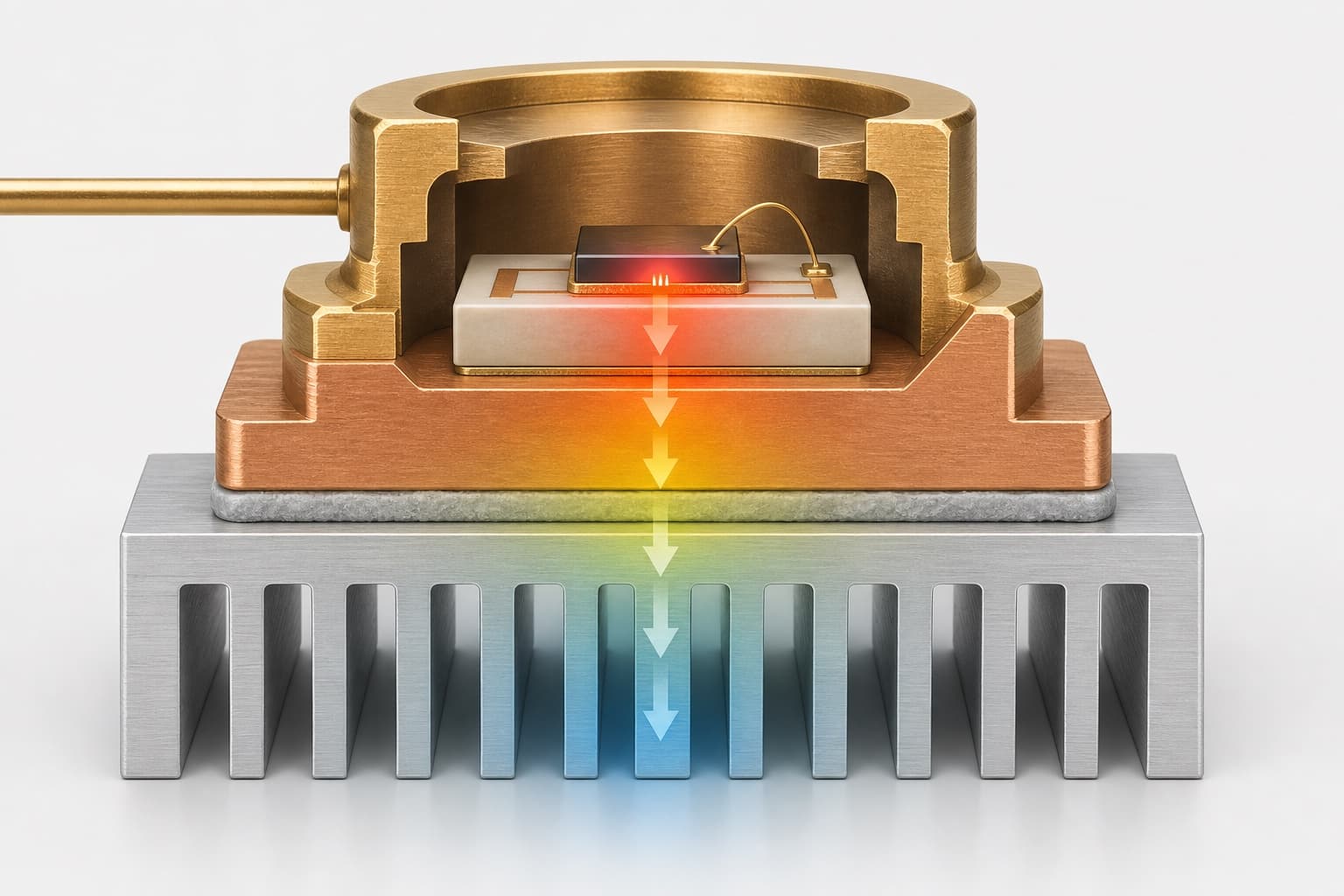
CW vs pulsed: different thermal questions
Pulsed lidar stresses peak power and short time constants. CW telecom transceivers, fiber pumps, and industrial sources stress steady-state Tj at full duty cycle. The stack is the same — die, attach, submount, package, TIM, sink — but CW fails when average power is underestimated or when in-plane spreading in the submount is ignored.
If you sized a pulsed stack, re-validate at 100% duty before reusing the same submount. Companion: thermal path for pulsed LiDAR.
Thermal resistance network
A useful first model sums layer resistances in series:
Tj − Tsink = Pdiss × (Rattach + Rspread + Rpkg + RTIM + Rsink)
| Layer | What drives R | Typical lever |
|---|---|---|
| Die attach (AuSn) | Void %, bond line thickness | Pre-deposited AuSn, void < 2% |
| Submount spreading | k, thickness, die vs pad area | SiC vs ALN; Cu DPC pattern |
| Package / header | Cu slug, TEC cold plate | TO60 slug; cooled vs uncooled |
| TIM to system | Material, pressure, flatness | Indium, phase-change |
| Heat sink | Fin area or liquid path | System / MCHS at high flux |
Submount: where FerraLink fits
The submount is the first spreading stage after the die. On a 300 µm × 500 µm stripe on a 3.5 mm × 4.5 mm tile, heat fans out in-plane before reaching the header wall. If Rspread is too high, the die sees a hot spot while the case still feels cool.
- ALN (170–210 W/m·K): InP/GaAs DFBs, moderate flux, strong CTE match.
- Single-crystal SiC (350–400 W/m·K): Pumps, bars, tight Tj margin.
Catalog: ALN submounts, SiC submounts · Compare: AlN vs SiC.
Power density → starting point
| Die power density | Submount starting point | Notes |
|---|---|---|
| < 10 W/cm² | ALN | Passive Cu sink often OK |
| 10–50 W/cm² | ALN or SiC | Validate attach + spreading |
| 50–100 W/cm² | SiC | Watch CTE vs die; TIM critical |
| > 100 W/cm² | SiC + advanced sink | MCHS / liquid common in literature |
Application checkpoints
| Application | CW class | Submount hint | Package |
|---|---|---|---|
| 10G/25G DFB | 50–150 mW optical | ALN often sufficient | Uncooled TO56 |
| Fiber pump 915/976 nm | 5–15 W | SiC spreading typical | TO60; TEC optional |
| Coherent / narrow λ | 100 mW–1 W | SiC + TEC | Cooled TO60 |
What you can decide here
- Which stack layers usually dominate R in CW modules.
- When ALN vs SiC is in the right class for your power density.
- That attach and TIM are not optional after picking ceramic k.
What still needs your numbers
- Rth j–c or Tj at max ambient and drive current.
- Whether wavelength, SMSR, or aging limits fail at predicted Tj.
- Header vs butterfly outline and PCB TIM under your module.
Already know this stack? Expand the technical review below — peer-reviewed interface R, packaged AlN vs SiC data, TIM degradation, and heat-sink literature we use internally before recommending SiC or ALN builds.
For experienced packaging engineers
Literature-backed CW thermal review
Peer-reviewed sources, interface data, and packaged-device literature — written by FerraLink materials engineering to support submount and attach decisions, not as neutral survey copy.
+20 minExpand literature-backed review ↓
For experienced packaging engineers
Literature-backed CW thermal review
Peer-reviewed sources, interface data, and packaged-device literature — written by FerraLink materials engineering to support submount and attach decisions, not as neutral survey copy.
FerraLink publishes this section for lead engineers who do not need another introductory explainer. We synthesize packaging literature relevant to ceramic submount selection, AuSn attach, and qualification — and state where our product line (DPC AlN/SiC tiles, pre-deposited AuSn) maps to published best practice.
1. Resistance networks and spreading
The series R model for CW operation treats die attach, submount spreading, package floor, TIM, and sink as sequential terms[Kim 2026]. Electrothermal work on packaged wide-bandgap devices reports that substrate and buffer layers can dominate total R in some GaN platforms; for laser submounts we treat in-plane spreading in the ceramic and attach interfaces as the terms procurement and assembly control directly.
Lateral spreading on a submount pad depends on k, thickness, and the ratio of stripe width to tile area. When Rspread is underestimated, the package case can feel cool while the facet region remains hot — a common failure mode in first-pass CW modules.
2. AlN vs SiC in real packages
Bulk k favors SiC, but assembled ΔT and residual stress matter. Gao et al. compared high-power blue-laser packages with AlN vs SiC heat spreaders and reported lower packaged thermal resistance for AlN despite SiC’s higher conductivity — attributed to CTE mismatch with GaN and higher post-attach stress[Gao 2024].
Li et al. documented high-thermal-conductivity polycrystalline AlN ceramics (~186 W/m·K) from surface-modified powder — relevant to supply-chain moisture sensitivity of raw AlN and lot-to-lot k variation in incoming inspection[Li 2023].
Cheng et al. reported wafer-scale cubic SiC with thermal conductivity exceeding 500 W/m·K at room temperature[Cheng 2022], supporting SiC as the spreading choice when power density forces the issue, provided attach and CTE are qualified on your die.
Walwil et al. measured thermal boundary conductance for GaN/AlN and AlN/SiC interfaces versus GaN/SiC directly — higher conductance on AlN-mediated interfaces[Walwil 2025], informing why metallization and buffer strategy on custom builds should be reviewed with spreading material together, not in isolation.
| Material | k (W/m·K) | CTE (~ppm/K) | CW note |
|---|---|---|---|
| Polycrystalline ALN | 170–210 | ~4.6 | Telecom / InP–GaAs; CTE match |
| Cubic SiC | 350–500 | ~3.8 | Pumps, bars; watch packaged Rth |
| Diamond | 1000+ | ~1 | Niche; cost and CTE |
3. Die attach and interface contact R
Deng et al. used thermal transient testing (T3ster) on high-power laser diode packages and found chip–solder interface R ≈ 0.38 K/W and solder–sink interface R ≈ 0.36 K/W — comparable magnitudes, underscoring that void-free AuSn attach is not a secondary detail[Deng 2024].
Miller et al. reported AuSn on composite copper platforms for laser bars with improved output and early reliability vs indium-bonded copper baselines[Miller 2008]. FerraLink’s pre-deposited AuSn on DPC AlN targets the same class of failure: eliminate preform placement variance and tighten void budgets before production release.
Ag sintering literature (power module context) shows substantially lower joint R and longer cycling life than grease-assisted SAC joints[Chen 2024] [Sakib 2024]. Laser hermetic lines remain AuSn-heavy; we cite sinter data so teams can justify process experiments, while noting NRE and equipment cost.
Dai et al. demonstrated bond-line thickness resolution for solder interfaces via transient thermal grating methods — supporting incoming criteria on thin, void-free attach layers[Dai 2025].
4. TIM and long-term R evolution
TIM must fill surface roughness, maintain low contact R, and survive cycling without pump-out. Huo et al. summarize substrate + TIM as the two functional material systems along the module heat path[Huo 2026]. Kim et al. note metal TIM alloys for large footprint packages[Kim 2021].
Advanced composites (liquid metal microspheres, aligned carbon nanofibers) report very high effective conductivity in lab configurations[Wang 2025] [Teng 2021]. For laser butterfly modules, indium and phase-change films remain the practical baseline; grease is typically limited to engineering bring-up.
Lall and Kumar show TIM–copper fracture toughness can degrade under temperature/humidity exposure, increasing R over life[Lall 2024] — relevant when a module meets bench Tj but drifts in field.
5. Heat sinks and system architecture
Xu et al. optimized laminated DC-mount packages with combined thermal–optical simulation, reporting meaningful Rth reduction from coordinated package design[Xu 2022]. Ding et al. showed diamond spreaders lowering Rth for high-power blue LDs vs ceramic references[Ding 2024] — an upper bound, not a default submount recommendation.
Amyx et al. demonstrated CuW microchannel sinks with dielectric coolant for very high flux (hundreds of W/cm² class on test vehicles)[Amyx 2025]. Wu et al. validated thermal–fluid models for microchannel cooling of diode laser bars[Wu 2019]. Lei et al. linked symmetric microchannel integration to lower stress in laser array packages[Lei 2025].
| Power density | Submount | Attach (literature) | Sink class |
|---|---|---|---|
| < 10 W/cm² | ALN | AuSn | Passive Cu |
| 10–50 W/cm² | ALN / SiC | AuSn | Passive Cu |
| 50–100 W/cm² | SiC | AuSn / Ag sinter | Cu or composite |
| > 100 W/cm² | SiC | Ag sinter (common in papers) | MCHS / liquid |
6. How FerraLink uses this body of work
We do not ask teams to pick ceramic from a datasheet alone. Typical engagement path:
- Benchmark attach on catalog ALN/SiC with pre-deposited AuSn (evaluation samples).
- Map power density → material band; if borderline, run Advisor or Stack Scoping memo.
- Before production freeze, measure Rth or commission Focused Analysis on the frozen stack drawing.
Emerging directions — sputtered AlN with engineered grain orientation[Vaziri 2024], liquid-metal elastomer TIM architectures[Kazem 2023] — are tracked for roadmap materials but are not required to solve most CW submount selections today.
References
S. Kim et al. (2026). Optimization factors for the thermal design of packaged GaN HEMTs. IEEE TED. DOI
X. Gao et al. (2024). Single-tube packaging of high-power blue semiconductor lasers — AlN vs SiC spreaders. ICOCN. DOI
G. Li et al. (2023). High-thermal-conductivity AlN ceramics from modified powder. Processes. DOI
Z. Cheng et al. (2022). High thermal conductivity in wafer-scale cubic SiC. Nat. Commun.. DOI
H. Walwil et al. (2025). Thermophysical properties of GaN/AlN/SiC epitaxial stacks (TDTR). J. Appl. Phys.. DOI
L. Deng et al. (2024). Interface contact thermal resistance of die attach in high-power laser diode packages. Electronics. DOI
R. L. Miller et al. (2008). Composite-copper heat sinks with AuSn for laser diode bars. Proc. SPIE. DOI
C. Chen et al. (2024). Ag-paste sinter joining for SiC power modules. IEEE TPEL. DOI
A. R. N. Sakib et al. (2024). Thermomechanical reliability of high-thermal die attach (RF/power). ECTC. DOI
J. Dai et al. (2025). Thermal transport across solder interfaces (transient thermal grating). Small Methods. DOI
Y. Huo et al. (2026). Advanced packaging materials for thermal management in power electronics. Adv. Sci.. DOI
Y. Kim et al. (2021). Metal TIM for next-generation FCBGA. ECTC. DOI
X. Wang et al. (2025). Liquid metal / diamond sandwich TIM. ACS Nano. DOI
W. Teng et al. (2021). Film TIM with vertically aligned carbon nanofibers. ICEP. DOI
P. Lall & M. Kumar (2024). TIM–copper fracture toughness under hygrothermal exposure. InterPACK. DOI
P. Xu et al. (2022). Laminated packaging structure for semiconductor laser diode. Coatings. DOI
Y. Ding et al. (2024). Diamond substrates for high-power blue LD heat spreading. IEEE LPT. DOI
I. Amyx et al. (2025). CuW microchannel heat sinks for high heat flux. IEEE TCPMT. DOI
D. Wu & C. Zhang (2019). Microchannel heat sink for diode laser bar. Appl. Opt.. DOI
C. Lei et al. (2025). Thermal stress optimization in laser array packaging. Electronics. DOI
S. Vaziri et al. (2024). Engineered AlN thermal films for 3D integration. Adv. Funct. Mater.. DOI
N. Kazem et al. (2023). Liquid metal embedded elastomers as TIM. IMAPSource. DOI
FerraLink selects citations for packaging relevance; verify against your program requirements before qualification sign-off.
The part that depends on your die
The rules above hold for most edge-emitter modules. What changes from program to program is geometry, duty cycle, and how hard you are pushing junction temperature — those inputs decide material, thickness, and whether catalog samples are enough.
- Rth j-c or Tj at max ambient for your die size, duty cycle, and attach void map.
- Whether spreading, TIM, or header slug is the bottleneck in your outline.
- Pass/fail vs wavelength lock, aging, or ERP at predicted Tj.
Go deeper — Thermal path
These guides answer adjacent questions teams ask while choosing a submount. Each ends the same way: what you can decide in general, then what needs your die and power.
- FMCW Phase Noise and Junction Temperature Stability10 min · Why coherent lidar and FMCW ranging tie phase noise to Tj drift during chirp — when cooled TO header…
- Transient Thermal and Duty Cycle for LiDAR and Radar Emitters10 min · Peak junction temperature vs average power in pulsed lidar and radar — duty cycle, pulse width, PRF,…
- Thermal Path Design for Pulsed LiDAR Emitters: Junction to Heat Sink6 min · Pulsed 905 nm lidar emitters need heat to spread through the submount faster than the pulse duration…
- FMCW vs. Pulsed LiDAR: What the Packaging Requirements Tell You8 min · Submount material, package format, TEC, and optical window requirements differ fundamentally between…
More topics coming — thermal path, attach yield, qualification, and packaging context.