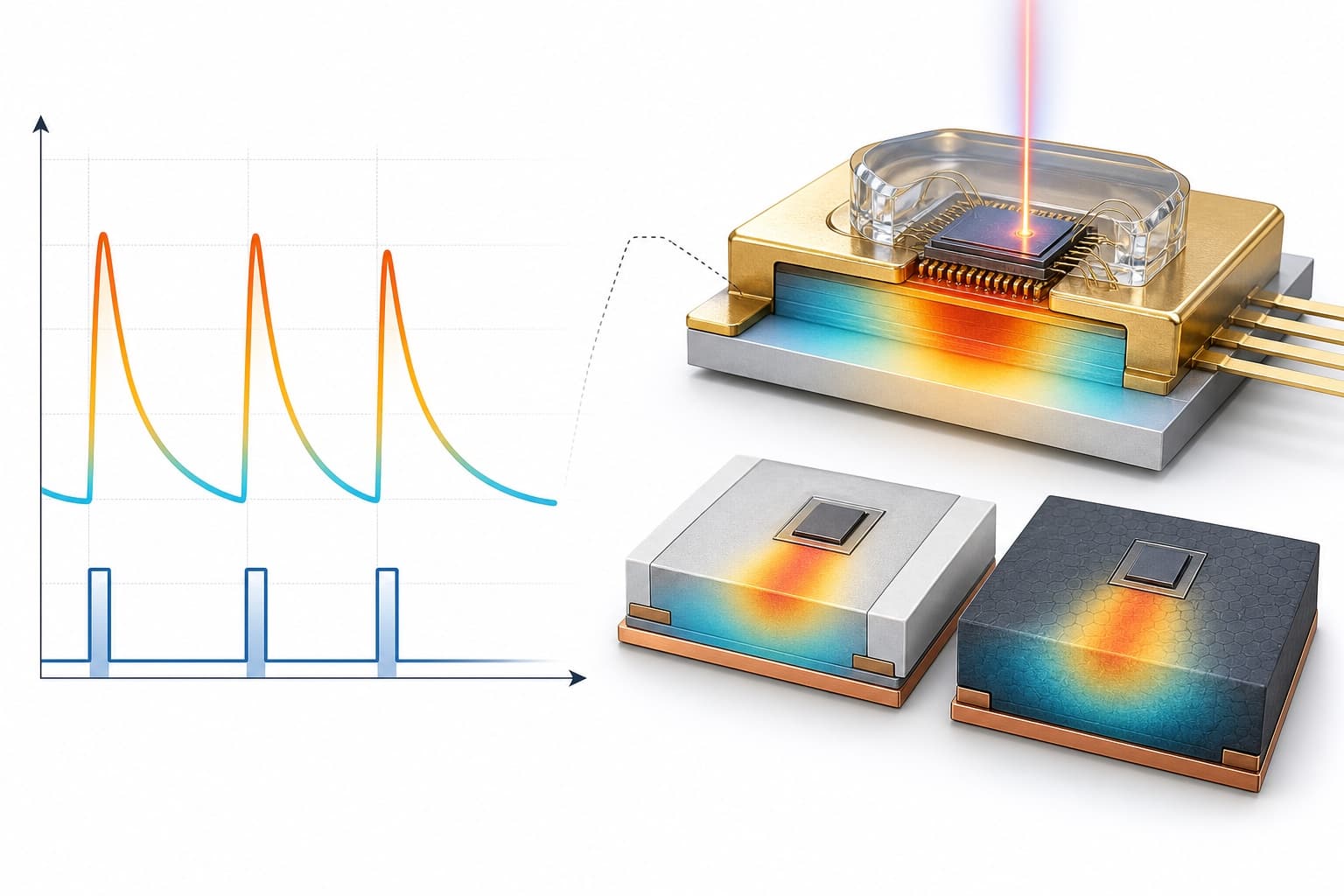
Peak vs average — different sizing problems
Tj,peak during a pulse drives wavelength chirp, facet catastrophic optical damage (COD), and eye-safety margins. Average power sets heat-sink and module dissipation. A 100 W peak / 0.1% duty stack behaves nothing like 5 W peak / 10% duty at the junction — even when average watts look similar.
Companions: pulsed LiDAR thermal path · CW thermal path · FMCW vs pulsed packaging · AlN vs SiC.
Three pulse regimes
| Pulse regime | Typical example | Dominant concern | Submount hint |
|---|---|---|---|
| Ns, low PRF | 10 ns @ 1 kHz | Facet intensity; minimal ΔT in pulse | ALN often sufficient |
| µs, kHz–MHz PRF | 100 ns @ 100 kHz | Thermal mass + spreading; burst buildup | Single-crystal SiC common |
| Quasi-CW / FMCW | > 1% duty or continuous chirp | Steady-state R_th; heat sink | CW thermal guide; TEC if FMCW |
Duty-cycle regimes (A / B / C)
| Regime | Example | What limits design |
|---|---|---|
| A — Peak-limited | 100 W peak, 10 ns, 1 kHz (~1 mW avg) | Facet COD, Z_th(0+); avg power negligible |
| B — Transient-mediated | 100 W peak, 100 ns, 100 kHz (~1 mW avg) | Incomplete inter-pulse cooling; simulate burst T_j |
| C — Average-limited | 100 W peak, 500 ns, 1 MHz (~5 W avg) | Approaches CW; size sink on P_avg × R_th(∞) |
Identify your regime before picking submount material or a heat-sink class. Regime B is where teams most often under-spec spreading.
Submount starting points
| Application band | PRF / duty (typical) | Submount |
|---|---|---|
| Flash / ns ToF | 1–10 kHz, < 0.001% | ALN; facet limits dominate |
| Scanning 905 / 1550 nm | 10–100 kHz, 0.001–0.1% | ALN or SiC — verify burst T_j |
| High PRF µs pulse | 100 kHz–5 MHz, 0.01–1% | SiC preferred |
| FMCW / quasi-CW | Continuous sweep, > 1% duty | CW stack; AlN/SiC + stabilization |
FerraLink catalog: ALN submounts (DFB, moderate flux) · SiC submounts (pulsed lidar, bars, high peak flux). Attach quality still dominates — see AuSn void inspection.
What you can decide here
- Whether your mission is peak-limited (A), burst-transient (B), or average-limited (C).
- Which pulse regime row matches your PRF and pulse width.
- When to escalate from ALN to single-crystal SiC for spreading, not just catalog habit.
What still needs your numbers
- Mission profile: PRF, pulse width, burst length, ambient range.
- Transient Z_th(t) or T3ster structure function on your die + attach + submount.
- Wavelength chirp, COD, or ERP margin at T_j,peak — especially FMCW linearity specs.
Running burst tests already? Expand the technical review — Z_th ladders, diffusion depth vs pulse width, FEM duty-cycle studies, and FMCW thermal sensitivity from the literature we use in Focused Analysis (T2).
For experienced packaging engineers
Literature-backed transient thermal review
Peer-reviewed sources, interface data, and packaged-device literature — written by FerraLink materials engineering to support submount and attach decisions, not as neutral survey copy.
+24 minExpand literature-backed review ↓
For experienced packaging engineers
Literature-backed transient thermal review
Peer-reviewed sources, interface data, and packaged-device literature — written by FerraLink materials engineering to support submount and attach decisions, not as neutral survey copy.
FerraLink publishes this section for lidar and radar thermal leads who already understand average-power heat sinks but need sourced context on transient junction behavior, duty-cycle buildup, and submount spreading — framed for ceramic tile selection on pulsed emitters, not as a generic survey.
1. Thermal impedance Z_th(t) and time constants
Transient junction response to a rectangular power pulse follows Tj(t) ≈ Tambient + Ppeak × Zth(t), where Zth is modeled as an RC ladder: early nanoseconds sample die and attach; microseconds engage submount spreading; milliseconds reach package and sink[Elattar 2024] [Privitera 2023].
Pulse width sets which part of Zth(t) you excite. A 5 ns pulse probes primarily Zth(0+) — junction-to-case spreading. A 5 µs pulse engages submount thickness and lateral spread. This is why identical average power at different duty cycles produces different Tj,peak and different submount requirements.
Wang et al. developed pulse-current sourcing for transient thermal impedance measurement with reduced non-thermal switching artifacts — relevant when calibrating simulation to lab Zth curves[Wang 2026].
2. Duty cycle, C_th, and quasi-steady buildup
Thermal capacitance Cth stores energy during the pulse; τ = Rth × Cth sets rise and fall. At low PRF, each pulse decays before the next — Tj,peak ≈ Tambient + Ppeak × Zth(0+). At high PRF or long pulse width, incomplete cooling creates cumulative elevation toward a quasi-steady plateau below the CW equivalent at Pavg.
Privitera et al. use transient thermal impedance with mission profiles for EV traction inverters — the same mission-profile mindset applies to lidar burst PRF schedules: worst-case is often a sustained burst at max PRF, not a single pulse[Privitera 2023].
3. Wavelength chirp, FMCW, and facet COD
Peak Tj during a pulse shifts refractive index (dn/dT ~ 10−4 K−1 class for III-V), producing wavelength drift that matters for DWDM and FMCW ranging. Liu et al. demonstrate fast-tuning hybrid lasers for FMCW where residual nonlinearity and linewidth depend on thermal stability during the sweep[Liu 2025]. Zhang et al. report FMCW generation via sideband injection locking for LiDAR — thermal drift during modulation remains a system-level budget item[Zhang 2026].
COD and facet damage scale with peak optical intensity, not average power. Zhang et al. analyzed dynamic COD growth in high-power diodes — nanosecond-class peak-to-average systems must margin facet intensity even when average dissipation is modest[Zhang 2016].
4. Interface resistance and attach voids
Zth(0+) includes die-attach contact resistance. Deng et al. measured chip–solder R ≈ 0.38 K/W in high-power laser packages — void fraction directly inflates early-time impedance and pulse overshoot[Deng 2024]. Transient models must be calibrated to measured structure functions, not ideal attach.
5. Regime-by-regime design notes
Nanosecond, kHz PRF: Thermal diffusion depth δ ≈ √(4ατ) at 10 ns stays in the ~1–2 µm class in the die — submount bulk is less engaged during the pulse itself. Pan et al. characterize nanosecond-pulse high-power-density VCSEL arrays for sensing — peak optical limits dominate[Pan 2025]. Nägele et al. report passively Q-switched 914 nm microchip lasers for lidar — short-pulse thermal mass is junction-local[Nägele 2021].
Microsecond, MHz PRF: Diffusion reaches 10–100 µm; inter-pulse intervals (10–100 µs at 10–100 kHz) compete with package τ. Elattar et al. FEM-simulated high-power diode laser stacks for high-duty-cycle pump applications — improved spreader materials reduce Zth by 20–40% as pulse width or duty increases, with smaller benefit at pure ns excitation[Elattar 2024]. This is the SiC sweet spot for FerraLink pulsed lidar tiles.
Quasi-CW / FMCW: Use steady-state Rth and CW thermal path methodology; add TEC or bias tuning when ±1–2°C drift breaks chirp linearity.
6. ALN vs single-crystal SiC under pulsed load
On FerraLink submounts: polycrystalline ALN ~170–210 W/m·K; single-crystal SiC ~350–400 W/m·K. For short pulses, spreading in the tile matters only after heat has time to enter the submount — SiC advantage grows with pulse width and duty. ALN remains appropriate for many ns/low-PRF edge emitters where facet limits and cost dominate; SiC is default for high peak flux pulsed lidar aligned with our 905 nm thermal path guide.
Vaziri et al. review engineered AlN for 3D integration — high-k AlN films and boundary conductance control matter at chiplet scale where diffusion depths approach film thickness[Vaziri 2024]. Hoque et al. measured in-plane k in AlN thin films and ballistic-to-diffusive phonon transport transitions — relevant when spreaders shrink below ~500 nm[Hoque 2021] [Hoque 2024].
7. Characterization workflow
- T3ster / transient Z_th — extract structure function; separate attach, submount, package terms[Wang 2026].
- FEM calibrated to measurement — sweep PRF, pulse width, ambient; Elattar et al. for stack-level duty-cycle FEM[Elattar 2024].
- Mission-profile burst test — worst-case PRF schedule, not single-shot lab pulse[Privitera 2023].
- Reliability at elevated T_j — wavelength, power, linewidth vs cycle count; Liang et al. on PCM-buffered overload in power modules illustrates transient buffering concepts for burst overload[Liang 2025].
8. Case study: 100 W peak, varying duty
| Duty / timing | Approx. P_avg | Thermal read |
|---|---|---|
| 10 ns @ 100 kHz (~0.1%) | ~100 mW | Single-pulse Z_th(0+); ALN often OK |
| 100 ns @ 1 MHz (~1%) | ~1 W | Quasi-steady overshoot; verify SiC spreading |
| 500 ns @ 1 MHz (~5%) | ~5 W | CW-class sink sizing; avg power limits |
9. How FerraLink applies this
- Catalog SiC tiles for pulsed lidar and high peak flux; ALN for moderate CW/pulsed telecom class — material choice follows regime B/C identification.
- Evaluation samples benchmark attach void map + reflow before PRF burst qualification.
- Advisor / Stack Scoping when mission profile spans regimes (ns flash + high-PRF burst on same die outline).
- Focused Analysis (T2) when customer supplies PRF table and needs simulated T_j,peak with measured Z_th.
References
M. Elattar et al. (2024). FEM thermal simulation of high-power diode laser stacks for high-duty-cycle pump applications. IEEE JSTQE. DOI
X. Wang et al. (2026). Pulse current source for transient thermal impedance measurement. IEEE JESTPE. DOI
E. Privitera et al. (2023). Junction temperature from transient Z_th for EV mission profiles. EPE. DOI
L. Deng et al. (2024). Interface contact thermal resistance of die attach in high-power laser diode packages. Electronics. DOI
G. Pan et al. (2025). Nanosecond-pulse characterization of high-power-density multi-junction VCSEL arrays. Opt. Express. DOI
M. Nägele et al. (2021). Passively Q-switched 914 nm microchip laser for lidar systems. Opt. Express. DOI
Q. Zhang et al. (2016). Dynamic analysis of catastrophic optical damage in high-power laser diodes. Sci. Rep.. DOI
C. Liu et al. (2025). Fast-tuning narrow-linewidth hybrid laser for FMCW ranging. Laser Photonics Rev.. DOI
R. Zhang et al. (2026). FMCW laser via sideband injection locking for LiDAR. IEEE LPT. DOI
S. Vaziri et al. (2024). AlN as engineered thermal material for 3D ICs. Adv. Funct. Mater.. DOI
Md. S. B. Hoque et al. (2021). High in-plane thermal conductivity of AlN thin films. ACS Nano. DOI
Md. S. B. Hoque et al. (2024). Ballistic to diffusive phonon transport in AlN thin films. Appl. Phys. Lett.. DOI
Y. Liang et al. (2025). Transient thermal assessment of power module with encapsulated PCM. IEEE TPEL. DOI
FerraLink selects citations for packaging relevance; verify against your program requirements before qualification sign-off.
The part that depends on your die
The rules above hold for most edge-emitter modules. What changes from program to program is geometry, duty cycle, and how hard you are pushing junction temperature — those inputs decide material, thickness, and whether catalog samples are enough.
- PRF, pulse width, and burst profile for your mission (not datasheet average power alone).
- Z_th(t) or T3ster structure function for your frozen die + attach + submount stack.
- Pass/fail on wavelength chirp, COD margin, or ERP at worst-case ambient and PRF.
Go deeper — Thermal path
These guides answer adjacent questions teams ask while choosing a submount. Each ends the same way: what you can decide in general, then what needs your die and power.
- FMCW Phase Noise and Junction Temperature Stability10 min · Why coherent lidar and FMCW ranging tie phase noise to Tj drift during chirp — when cooled TO header…
- Steady-State Thermal Path for CW Laser Diodes: Junction to Heat Sink10 min · Practical CW thermal path from junction to heat sink — plus an expandable literature-backed review f…
- Thermal Path Design for Pulsed LiDAR Emitters: Junction to Heat Sink6 min · Pulsed 905 nm lidar emitters need heat to spread through the submount faster than the pulse duration…
- FMCW vs. Pulsed LiDAR: What the Packaging Requirements Tell You8 min · Submount material, package format, TEC, and optical window requirements differ fundamentally between…
More topics coming — thermal path, attach yield, qualification, and packaging context.