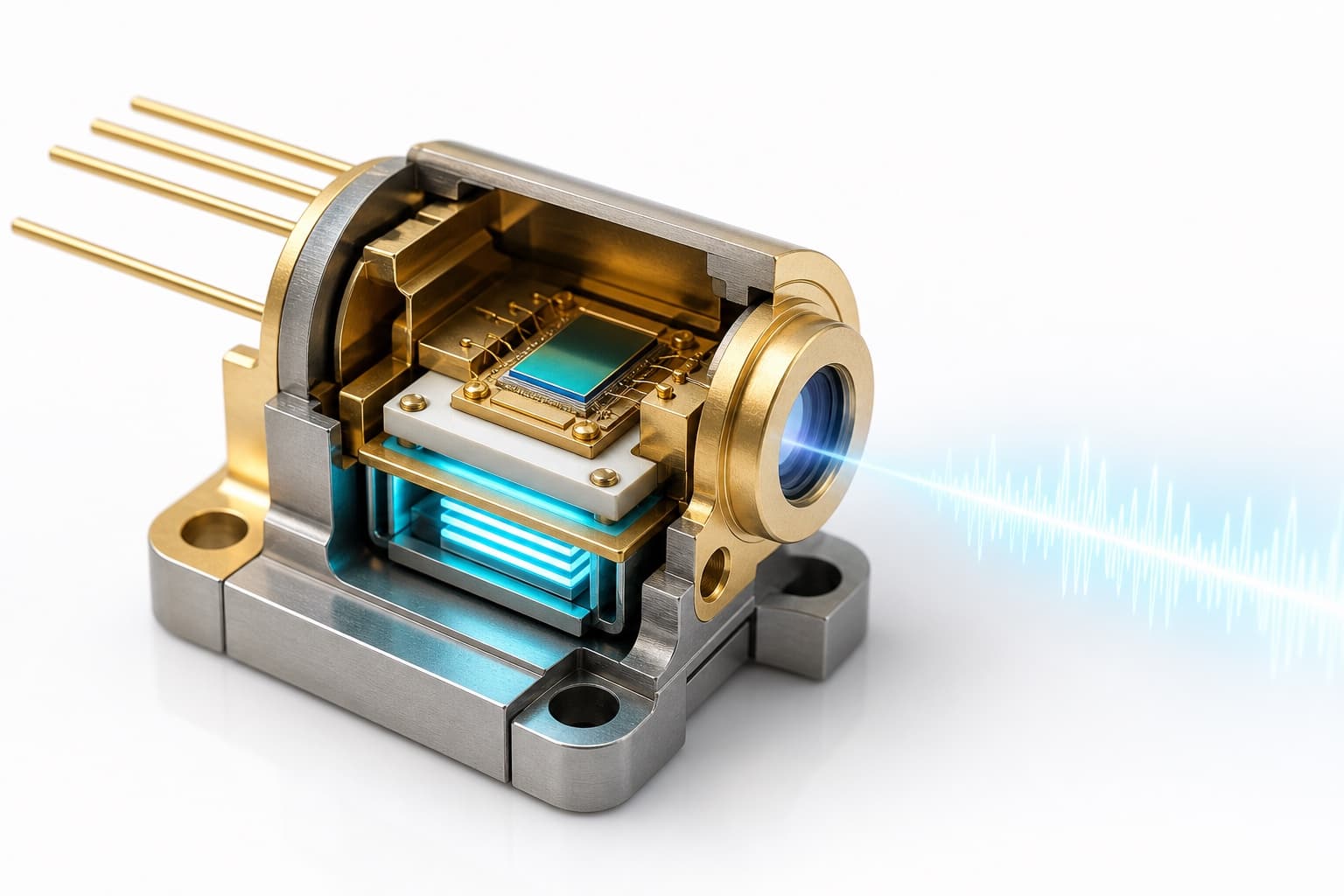
Beyond average power
Pulsed time-of-flight lidar sizes the die for peak facet intensity and nanosecond thermal mass. FMCW coherent lidar sizes the die for frequency stability during the chirp — linewidth, chirp linearity, and phase noise all move with junction temperature (Tj).
A few hundred milliwatts average dissipation can still fail an FMCW module if Tj ripples ±0.5–1°C during a 10 µs chirp. That is a packaging and control problem, not a heat-sink average-power problem alone.
Companions: FMCW vs pulsed packaging · TO header selection · transient thermal & duty cycle · CW thermal path · void inspection.
What Tj drift breaks in FMCW
- Linewidth / coherence length — broader linewidth shrinks unambiguous range.
- Chirp nonlinearity — current ramp heating shifts dν/dI mid-sweep.
- Wavelength lock margin — ~0.08–0.1 nm/°C class drift on InP DFBs at 1550 nm.
- Phase noise PSD — not all of it cancels in post-processing if reference laser drifts too.
Architecture bands
| Target | Typical stack | TEC power hint |
|---|---|---|
| Short range (< 10 m) | Uncooled TO56, 50–100 kHz linewidth | None |
| Automotive 10–50 m | Cooled TO60 + SiC or ALN + λ lock | 0.2–0.5 W |
| Long range / metrology | SiC + TEC + EO-PLL / narrow linewidth | 0.5–1 W |
TEC electrical power is often 2–3× optical dissipation for automotive-grade stabilization — acceptable when ranging precision depends on coherence, not on minimizing module watts alone.
Packaging stack (FerraLink view)
| Layer | FMCW lever |
|---|---|
| DFB on SiC or ALN submount | Minimize ΔT during chirp (350–400 vs 170–210 W/m·K class) |
| Low-void AuSn attach | Interface R drives transient overshoot — target < 2% void |
| Cooled TO60 + TEC + thermistor | λ lock loop; slow TEC vs fast chirp heating |
| Hermetic window + getter | Reference path stability over measurement epoch |
Product paths: SiC submount · ALN submount · void inspection.
What you can decide here
- Whether your range budget needs cooled + narrow linewidth or uncooled is enough.
- When single-crystal SiC submount beats ALN for chirp transient ΔT (not just catalog k at room temperature).
- That TEC stabilizes mean Tj — it does not follow 100 kHz chirp heating; pre-cool and minimize attach/submount R.
What still needs your numbers
- Chirp bandwidth, dwell time, PRF, and ambient (−40°C to +85°C automotive class).
- Coherence length vs target range (including beyond-Lc mitigation architecture).
- Measured Tj or linewidth under FMCW modulation on frozen hardware.
Architecting a coherent module? Expand the technical review — phase noise vs coherence length, SiC/TEC trade-offs, EO-PLL and dual-sideband cancellation literature, and how we scope T2 thermal + packaging studies.
For experienced packaging engineers
Literature-backed FMCW thermal & phase noise review
Peer-reviewed sources, interface data, and packaged-device literature — written by FerraLink materials engineering to support submount and attach decisions, not as neutral survey copy.
+24 minExpand literature-backed review ↓
For experienced packaging engineers
Literature-backed FMCW thermal & phase noise review
Peer-reviewed sources, interface data, and packaged-device literature — written by FerraLink materials engineering to support submount and attach decisions, not as neutral survey copy.
FerraLink publishes this section for coherent lidar and telecom module engineers specifying DFB packages, submounts, and TEC loops together. We synthesize FMCW phase-noise and thermal literature — aligned to single-crystal SiC and DPC ALN products used in precision attach builds.
1. FMCW vs pulsed: why thermal specs diverge
FMCW encodes range in beat frequency fbeat ∝ 2Δf·τ/Tchirp and extracts velocity from Doppler shift[Zhong 2026] [Sun 2025]. Coherent detection improves sensitivity versus pulsed ToF but ties performance to laser linewidth and phase noise during the chirp[Yi 2023] [Pérez 2025].
Coherence length scales inversely with linewidth: a 100 kHz-linewidth source at 1550 nm supports roughly kilometer-class Lc in first order; megahertz-class linewidth collapses Lc to tens of meters. Phase noise that is not common-mode (speckle, turbulence) cannot be removed in DSP — minimizing Tj ripple during chirp remains a hardware lever[Yi 2023].
2. DFB temperature sensitivity
InP DFBs at 1550 nm show wavelength drift ~0.08–0.1 nm/°C and linewidth broadening with Tj[Asmari 2017] [Zhong 2026]. Direct-modulation chirps add transient heating: current ramp can raise Tj 1–2°C during a microsecond-class chirp, degrading linearity unless pre-cooled or corrected[Zhang 2024] [La 2024].
Delayed self-heterodyne linewidth tests show sub-20 kHz steady-state performance on stabilized modules; under FMCW drive, effective linewidth can inflate to 30–50 kHz if Tj ripple exceeds ~0.5°C during the sweep[La 2024]. Integrated photonic lasers achieve narrower lines with self-injection locking for coherent ranging platforms[Lihachev 2022].
3. Phase noise mitigation (system)
Auxiliary interferometers record laser phase noise for electrical cancellation[Ke 2022]. Dual-sideband residual-carrier modulation enables long-distance FMCW despite MHz-class linewidth lasers[Zhong 2026]. Dual-wavelength and symmetrical dual-sideband opposing-chirp schemes extend usable range beyond intrinsic Lc[Pu 2020] [Zhi 2023]. These architectures still need a stable reference laser — Tj drift on the reference corrupts cancellation[Yi 2023].
4. SiC submount and attach
On FerraLink parts, single-crystal SiC is ~350–400 W/m·K; polycrystalline ALN is ~170–210 W/m·K. Su et al. reported 1550 nm high-speed DFB on high-thermal-conductivity SiC substrate for packaging studies[Su 2025]. Gao et al. compared AlN vs SiC spreaders in high-power blue-laser packages — packaged peak temperature can favor better-matched SiC despite bulk k debates[Gao 2024]. Heterogeneous III-V on SiC integration removes one attach interface for research platforms[Koscica 2023].
Production FMCW modules still use discrete DFB + submount. Void fraction on AuSn attach increases Rth,jc — target under 2% void for precision builds per FerraLink attach guidance[Giap 2024] [Li 2025]. Pre-deposited AuSn on DPC tiles reduces preform variance documented in our void inspection guide.
5. TEC integration and power
TEC COP is modest at large ΔT; automotive FMCW often needs ~10–20°C junction margin below ambient extremes while holding ±1°C during chirping[Parnika 2024] [Pei 2020]. TEC thermal time constants (seconds) cannot track 100 kHz chirp heating — design centers mean Tj with fast wavelength feedback on the laser and slow TEC on the mean[Liu 2025]. Micro-TEC in glass substrates is an emerging packaging option for photonic modules[Parnika 2024].
6. Chirp linearity: EO-PLL and predistortion
EO-PLL with repetitive control on FPGA achieves highly linear frequency tuning for FMCW lidar[Hauser 2021] [Xue 2025]. Deep reinforcement learning compensation reduces residual nonlinearity with temperature-aware training[Li 2025]. SiC + TEC reduce the thermal component of nonlinearity; EO-PLL handles residual laser dynamics — together they define current automotive sweet spots[Zhong 2026].
7. Cooled TO60 stack
Typical production stack: DFB on SiC or ALN submount → low-void AuSn → TO-60 leadframe → Peltier → thermistor → hermetic cap. Wavelength-locked DFB arrays demonstrate integrated λ control for FMCW transmitters[Fan 2025]. Laser-assisted bonding processes target thermally sensitive hermetic assemblies[Hu 2024]. Hermetic window AR coating and seal chemistry affect reference-path drift over the measurement epoch — scope with your optical-window spec in parallel.
8. Design comparison table
| Parameter | Uncooled | TEC + SiC/ALN |
|---|---|---|
| Linewidth (typical) | 50–100 kHz | 10–50 kHz |
| Coherence length | 3–15 m order | 30–150 m order |
| Chirp nonlinearity target | < 1% | < 0.1% (often + EO-PLL) |
| Tj stability (ambient span) | ± 3°C class | ± 1°C class |
| TEC electrical power | 0 W | 0.2–0.5 W typical |
9. How FerraLink applies this
- Map target range and chirp profile → decide uncooled vs cooled vs EO-PLL tier.
- Recommend SiC submount when chirp transient ΔT or peak flux threatens linewidth; ALN when moderate CW + TEC dominates.
- Supply pre-deposited AuSn tiles for void-stable attach before λ-lock qualification.
- Focused Analysis (T2): measured Tj ripple vs chirp on customer stack drawing.
References
T. Zhong et al. (2026). Overcoming laser phase noise in FMCW LiDAR via dual-sideband residual-carrier modulation. IEEE LPT. DOI
W. Yi et al. (2023). Impact of laser phase noise on FMCW ranging precision within and beyond coherence length. OFC. DOI
J. Pérez Santacruz et al. (2025). Analysis and compensation of phase noise in FMCW LiDAR sensors. J. Lightwave Technol.. DOI
X. Sun et al. (2025). FMCW laser ranging beyond bandwidth and phase noise limits. APL Photonics. DOI
L. Zhang et al. (2024). Directly modulated FMCW tunable laser with linear chirp and narrow linewidth. APL Photonics. DOI
J. La et al. (2024). In situ linewidth measurement for FMCW LiDAR. AIP Advances. DOI
G. Lihachev et al. (2022). Low-noise photonic integrated lasers for coherent ranging. Nat. Commun.. DOI
J. Ke et al. (2022). Long-distance FMCW ranging with phase noise compensation. Appl. Opt.. DOI
A. Asmari et al. (2017). All-electronic frequency stabilization of a DFB laser diode. Opt. Express. DOI
Y. Su et al. (2025). 1550 nm DFB on high-thermal-conductivity SiC substrate. ICOSI. DOI
X. Gao et al. (2024). High-power blue laser packaging — AlN vs SiC spreaders. ICOCN. DOI
R. Koscica et al. (2023). Quantum dot laser heterogeneously integrated on SiC. Opt. Lett.. DOI
M. G. Hauser & M. Hofbauer (2021). FPGA-based EO-PLL for FMCW LiDAR frequency tuning. IEEE Photon. J.. DOI
C. Liu et al. (2025). Fast-tuning narrow-linewidth hybrid laser for FMCW ranging. Laser Photonics Rev.. DOI
P. Gupta et al. (2024). Substrate integrated micro-TEC for photonic packages. J. Opt. Microsystems. DOI
M. Pu et al. (2020). Dual-heterodyne phase noise cancellation for dual-wavelength FMCW lidar. OFC. DOI
Y. Zhi et al. (2023). Symmetrical dual-sideband oppositely chirped differential FMCW LiDAR. Opt. Express. DOI
A. O. Giap et al. (2024). SiC power package die attach — pressure-less sintering reliability. EPTC. DOI
Z. Li et al. (2025). SiC discrete package — pressure-less sintering attach study. ICEPT. DOI
J. Pei et al. (2020). Bi₂Te₃ thermoelectric materials — advances and challenges. Natl. Sci. Rev.. DOI
T. Xue et al. (2025). FMCW ranging with EO-PLL and NUDFT on semiconductor laser. Photonics. DOI
Z. Li et al. (2025). FMCW nonlinearity compensation via deep reinforcement learning. Photonics. DOI
Y. Fan et al. (2025). Wavelength-locked high-density integrated DFB array for FMCW. Opt. Express. DOI
S. Hu et al. (2024). Laser-assisted bonding for thermally sensitive hermetic packaging. IEEE TCPMT. DOI
FerraLink selects citations for packaging relevance; verify against your program requirements before qualification sign-off.
The part that depends on your die
The rules above hold for most edge-emitter modules. What changes from program to program is geometry, duty cycle, and how hard you are pushing junction temperature — those inputs decide material, thickness, and whether catalog samples are enough.
- Chirp bandwidth, PRF, target range, and required ranging precision (cm vs m class).
- Ambient temperature span and whether λ lock or EO-PLL is in your architecture.
- Measured Tj ripple during FMCW modulation on your frozen submount + attach stack.
Go deeper — Thermal path
These guides answer adjacent questions teams ask while choosing a submount. Each ends the same way: what you can decide in general, then what needs your die and power.
- Transient Thermal and Duty Cycle for LiDAR and Radar Emitters10 min · Peak junction temperature vs average power in pulsed lidar and radar — duty cycle, pulse width, PRF,…
- Steady-State Thermal Path for CW Laser Diodes: Junction to Heat Sink10 min · Practical CW thermal path from junction to heat sink — plus an expandable literature-backed review f…
- Thermal Path Design for Pulsed LiDAR Emitters: Junction to Heat Sink6 min · Pulsed 905 nm lidar emitters need heat to spread through the submount faster than the pulse duration…
- FMCW vs. Pulsed LiDAR: What the Packaging Requirements Tell You8 min · Submount material, package format, TEC, and optical window requirements differ fundamentally between…
More topics coming — thermal path, attach yield, qualification, and packaging context.