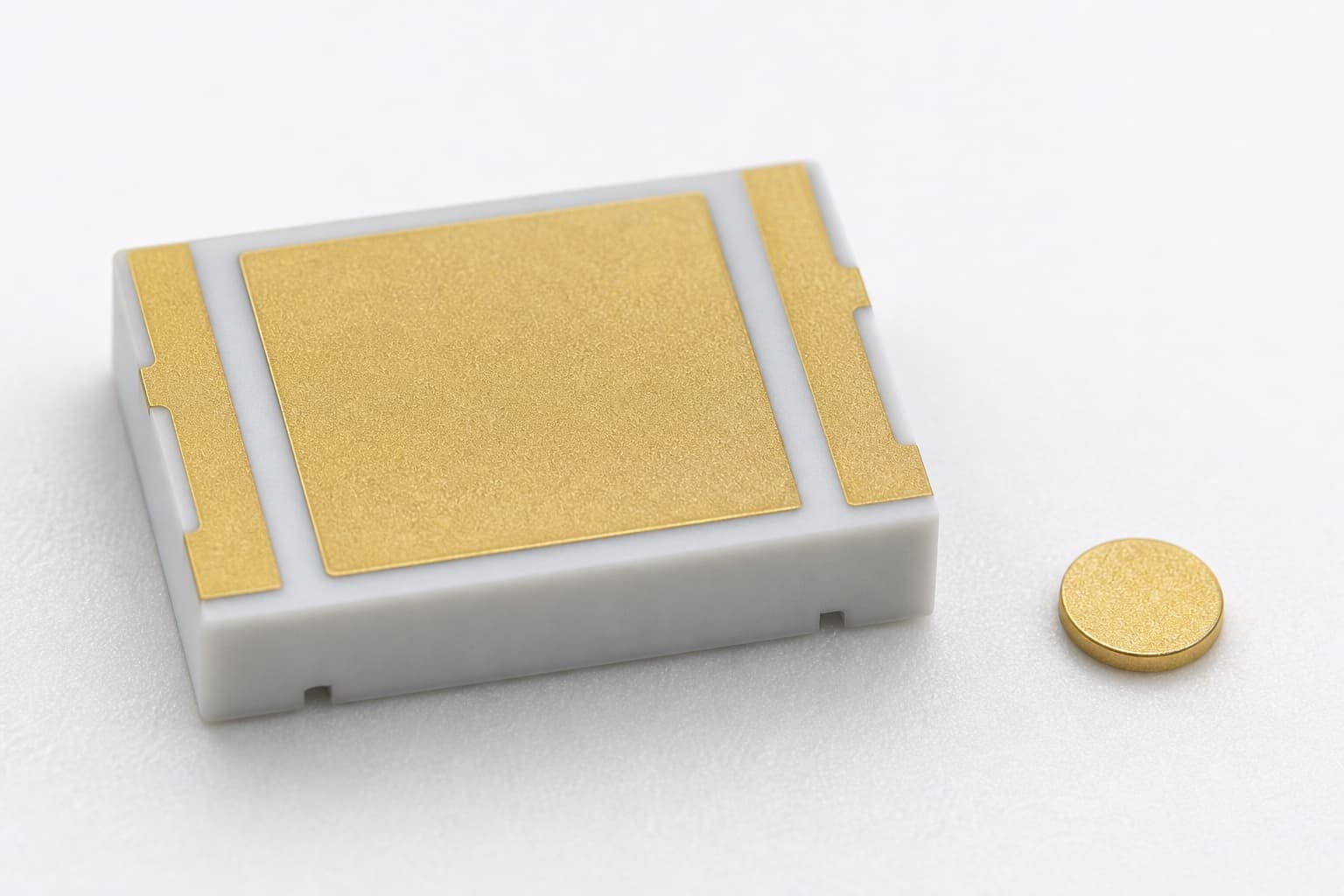
Two ways to get AuSn on the pad
Au/Sn 80/20 (~280°C eutectic) is the default high-temperature attach for hermetic laser modules. You either place a discrete solder preform (stamped foil, typically 20–50 µm thick) immediately before die attach, or buy a submount with pre-deposited AuSn (electroplated or PVD, often 3–5 µm on the die pad only) from the ceramic vendor.
The alloy is the same; the manufacturing path is not. Preforms add handling, oxidation, and placement variance. Pre-deposited solder is already aligned to your pad geometry and stays under controlled storage until reflow. For edge-emitting lasers, bondline voids and die tilt are wavelength problems — not just yield problems.
Companions: AuSn pre-deposited submounts · void inspection · ALN submount · SiC submount.
Decision tree (laser packaging)
- Pad width < 1 mm or pad area < ~1 mm² (edge emitter)? → Pre-deposited — preform placement error and rollover dominate scrap.
- Prototype or < ~5k modules/month without a qualified preform cell? → Pre-deposited — no die-specific preform tooling or reel logistics.
- Void spec ≤ 2% (telecom / coherent) or stripe must stay void-free? → Pre-deposited + N₂ or vacuum peak — see void guide bands.
- Void spec 2–5% commercial CW? → Pre-deposited preferred; preforms viable only with disciplined reflow and incoming X-ray.
- Pad > ~1.5 mm, > ~15–20k modules/month, mature pick-place and compression/reflow? → Evaluate preform $/joint — include scrap from misalignment.
- Rework / die replacement on same submount is mandatory? → Preforms or fresh preform + localized reflow — pre-deposited submounts are usually consume-once.
- Indium or flux attach process? → Not this tree — see indium/epoxy attach draft.
Default for new laser programs: pre-deposited unless volume, pad size, and rework requirements clearly favor preforms.
Side-by-side (typical laser lines)
| Factor | Pre-deposited AuSn | Solder preform |
|---|---|---|
| Pad area sweet spot | < 1 mm² to ~2 mm² | ~1.5 mm² and larger |
| Void area (optimized) | Often < 2% | Often 5–15% without vacuum/N₂ |
| Handling steps | Die place + reflow | Preform place + die + reflow |
| Solder freshness | Sealed submount to reflow | Reel exposure; oxidation risk |
| New die size | Pad artwork change | New preform punch / MOQ |
| Rework | Difficult — new submount | Replace preform feasible |
| Volume economics | Strong < 15k/mo | Crossover ~15–25k/mo class |
Void spec drives the call
Voids are thermal resistors at the junction. A void under the ridge can shift DFB wavelength by several °C of effective Tj margin. Pre-deposited pads wet from the ceramic up — no trapped air at a preform perimeter. Production programs targeting < 2% total void area by X-ray overwhelmingly standardize on pre-deposited submounts; preforms remain common in cost-driven bands where 5–10% is still engineering-reviewed.
| Void target | Recommendation |
|---|---|
| ≤ 2% telecom / DWDM | Pre-deposited + controlled reflow |
| 2–5% datacom / industrial | Pre-deposited preferred; preform with vacuum |
| > 5% prototype | Either; tighten before production |
Process levers (both paths)
- Atmosphere: N₂ or forming gas at peak; vacuum assist when spec < 3% void.
- Pad finish: Ti/Pt/Au or Ti/Ni/Au under AuSn — ENIG/ENEPIG quality affects Ni-Sn voiding at the UBM.
- Profile: Short time above 280°C liquidus; avoid excessive IMC growth on repeated reflow.
- Placement: Pick-place force during peak for preforms; pre-deposited removes preform alignment DOE.
FerraLink ships selectively pre-deposited Au/Sn 80/20 on DPC AlN and SiC — benchmark void maps on evaluation samples before locking attach qualification.
What you can decide here
- Whether your pad and volume fit the pre-deposited default or a preform crossover.
- How void % in your spec maps to material choice (not just reflow tuning alone).
- That rework flexibility is the main reason to keep preforms in mature high-volume lines.
What still needs your numbers
- Pad L×W, die footprint, and target standoff / bondline (µm).
- Monthly volume, existing preform cell, and $/joint including scrap.
- X-ray void map vs Tj or λ on golden units for your reflow ID.
Choosing attach for a new DFB or pump program? Expand the technical review — AuSn IMC growth, hydrogen and Kirkendall voids, pad-finish literature, thermal cycling, and FerraLink pre-deposition scope.
For experienced packaging engineers
Literature-backed AuSn preform vs pre-deposited review
Peer-reviewed sources, interface data, and packaged-device literature — written by FerraLink materials engineering to support submount and attach decisions, not as neutral survey copy.
+22 minExpand literature-backed review ↓
For experienced packaging engineers
Literature-backed AuSn preform vs pre-deposited review
Peer-reviewed sources, interface data, and packaged-device literature — written by FerraLink materials engineering to support submount and attach decisions, not as neutral survey copy.
FerraLink positions this review for laser module and photonics attach engineers choosing AuSn on ALN/SiC submounts. We bias toward pre-deposited Au/Sn on DPC tiles where void and pad-size constraints match telecom and industrial emitter programs — while documenting when preforms remain economically rational.
1. AuSn 80/20 fundamentals
The Au-Sn eutectic near 80 wt% Au / 20 wt% Sn melts at ~280°C and is widely used for hermetic, high-temperature die attach[Heran 2019] [Ma 2024]. Off-eutectic compositions form mixed (Au,Ni)Sn and brittle IMC phases that change shear and fatigue response[Rautiainen 2018]. CALPHAD work on related Au-Sb-Sn systems supports composition control in advanced lead-free stacks[Ge 2023].
During reflow, Au dissolves into Sn and AuSn₄-type IMCs grow with kinetics set by temperature, time above liquidus, and pad metallization[Darayen 2017] [Holcomb 2001]. For laser modules, the practical limit is keeping IMC thickness and void fraction low enough that Rth,jc and beam pointing stay inside spec.
2. Pre-deposited pads: manufacturing control
Pre-deposited AuSn is applied on the die pad during submount metallization — electroplating or PVD with selective masking so wire-bond and optical features stay bare Au[Wang 2023] [Zhang 2024]. Thickness control (±0.5 µm class on plating lines) sets bondline volume more repeatably than stamped preforms at ±5–10 µm foil tolerance. Sub-mm pads are where preform pick-place scrap dominates[Wen 2008].
Pad finish under the solder matters: ENEPIG and high-quality ENIG studies show finish choice shifts voiding and joint reliability in demanding assemblies[Gim 2022]. Ni-Sn sporadic voiding ties to electroplated Ni chemistry versus high-purity Ni[Dimitrov 2024] — relevant when specifying UBM on incoming submounts.
3. Preforms: flexibility and volume economics
Punched or sintered AuSn preforms enable rework, sequential multi-die attach, and bonding to generic metallized pads without vendor-specific predep[Syed-Khaja 2019] [Rautiainen 2018]. Solid-liquid interdiffusion (SLID) and thermal-compression bonding at 250–300°C under pressure can produce dense joints when oxides are reduced and alignment is tight[Rautiainen 2018].
Economics favor preforms when pad area is large enough, monthly volume amortizes tooling, and an existing flip-chip or compression line is qualified. Below ~15k modules/month on sub-mm pads, preform MOQ and placement yield often lose to pre-deposited submount cost.
4. Void formation: why predep wins spec
Large voids in flip-chip solder come from hydrogen evolution, flux residues, and entrapment during rapid heating[Ramos 2025] [Lentz 2023]. Preforms handled in ambient air absorb moisture; pre-deposited solder on sealed ceramics reflows with less outgassing at the pad edge. PCB pad-contamination studies show organics trapped at interfaces drive localized voids — the same lesson applies to gold pad cleanliness before AuSn wetting[Eckel 2001].
Kirkendall porosity in Cu-Sn systems illustrates asymmetric diffusion risk when Cu pillars or thick Cu UBM are present[Tatarchuk 2024] [Tatarchuk 2025] [Wang 2024]. Laser submounts on AlN/SiC with Ti/Pt/Au reduce Cu dissolution versus Cu-pillar flip-chip, but repeated reflow still grows IMC and can reopen voids[Nie 2009].
FerraLink production guidance aligns with our void inspection article: target < 2% area for precision emitters; correlate void maps to Tj before release.
5. Reliability: thermal cycling and EM
Micro-solder joint fatigue reviews emphasize crack initiation at IMC interfaces and void stress concentrators[Li 2024] [Brinlee 2023]. Flip-chip studies report microvoids near cathodes can cut electromigration life to ~0.4× void-free bumps at high current density[Murayama 2025] — less common on low-current DFBs but relevant for pump arrays and high-drive RF dies.
Board-level FCCSP thermomechanical data reinforce that void-free statistics tighten life prediction confidence for automotive-class programs[Zhang 2025]. Drop and encapsulation work on SJEM shows underfill shifts stress — compatible with both attach types if void level is matched[Radhakrishnan 2017].
6. ALN / SiC submount context
Ceramic submounts (AlN ~4–5 ppm/K CTE; SiC ~3–4 ppm/K) set joint shear stress during −40°C to +125°C cycling. Pre-deposited stacks let the vendor tune Ti/Pt/Au adhesion per substrate. AuSn on DPC AlN is the default telecom path; SiC submounts appear where spreading dominates — attach alloy choice is unchanged, pad size and void spec still drive predep.
7. Reflow vs compression profiles
Typical pre-deposited reflow: moderate preheat (150–200°C), ramp to ~280°C liquidus, 10–30 s above liquidus, controlled cool — often with N₂ at peak. Preform compression bonding applies 5–20 MPa during SLID to squeeze entrapped gas; alignment and oxide removal remain critical[Rautiainen 2018].
Emerging fast attach (intense pulsed light, laser-assisted bonding) may shorten cycle time for large flip-chip; watch IMC and void metrics on small laser pads before adopting[Ju 2025] [Sarr 2025].
8. Decision summary table
| Criterion | Pre-deposited | Preform |
|---|---|---|
| Pad < 1 mm² | Strong yes | High scrap risk |
| Void ≤ 2% | Strong yes | Only with vacuum + strict IQC |
| Volume < 15k/mo | Yes | Tooling hard to justify |
| Rework required | Replace submount | Preform replace |
| New die sizes often | Artwork only | New punch each |
9. How FerraLink applies this
- Recommend pre-deposited Au/Sn 80/20 (3–5 µm) on die pads for edge emitters and sub-mm pads.
- Supply DPC AlN/SiC with selective predep; bare Au on wire-bond and alignment features.
- Point attach qualification to X-ray void limits and reflow DOE on evaluation lots.
- Reserve preform discussion for large-pad, high-volume, rework-centric programs only.
References
H. Zhao et al. (2019). Process parameters vs microstructure in AuSn seals. ICEPT. DOI
Y. Ma et al. (2024). Dual-cluster interpretation of Au–Sn eutectics. AIP Advances. DOI
A. Rautiainen et al. (2018). Wafer-level AuSn/Pt SLID bonding. IEEE TCPMT. DOI
J. Darayen et al. (2017). Au-Sn diffusion couple microstructure near eutectic. Engineering Journal. DOI
J. Ge et al. (2023). Thermodynamic description of Au-Sb-Sn. Metals. DOI
A. Syed-Khaja (2019). Diffusion soldering for high-temperature power packaging. FAU OPUS. DOI
S. Wang et al. (2023). Electroless plating surface modification for ceramic packaging. Materials. DOI
S. Zhang et al. (2024). Solder-on-pad process for multi-chip modules. ICEPT. DOI
G. Gim et al. (2022). ENEPIG finish and solder joint reliability. EPTC. DOI
N. Dimitrov et al. (2024). Sporadic voiding in Ni-Sn joints. ECS Meeting Abstracts. DOI
F. Wen et al. (2008). Lead-free paste selection for copper stud flip chip. EMAP. DOI
J. Ramos et al. (2025). Cause and prevention of large voids in flip-chip solder. IMAPSource. DOI
T. Lentz et al. (2023). Solder joint voiding reduction. SMTA webinar. DOI
S. Eckel et al. (2001). PCB pad finish and BGA voiding. Pan Pacific Symposium. DOI
Ye. Tatarchuk & M. Pasichnyy (2024). Cu₃Sn porosity in Cu-Sn reactive diffusion. Cherkasy Univ. Bull.. DOI
Ye. Tatarchuk et al. (2025). Cu grain size vs IMC kinetics in Cu–Sn. Cherkasy Univ. Bull.. DOI
Y. Wang et al. (2024). Temperature cycling of copper pillar solder joints. IEEE TCPMT. DOI
L. Nie et al. (2009). Cu pad dissolution and reworked package microstructure. JSMT. DOI
K. Murayama et al. (2025). Microvoids and β-Sn anisotropy in flip-chip bumps. IEEE TCPMT. DOI
L. Li et al. (2024). Thermal fatigue failure of micro-solder joints — review. Materials. DOI
S. Brinlee et al. (2023). Physics-of-failure flip-chip fatigue modeling. IMAPSource. DOI
Y. Zhang et al. (2025). Board-level thermomechanical reliability of FCCSP. EuroSimE. DOI
J. Radhakrishnan et al. (2017). SJEM on SnAgCu joints — thermal mechanical reliability. Regional Events. DOI
M. Holcomb et al. (2001). Plated gold thickness effects on wirebond and BGA shear. SMTA. DOI
Y.-M. Ju et al. (2025). Ultra-ms flip-chip bonding via intense pulsed light. ACS AMI. DOI
C. Sarr et al. (2025). Laser-assisted bonding for very large flip chips. IMAPSource. DOI
FerraLink selects citations for packaging relevance; verify against your program requirements before qualification sign-off.
The part that depends on your die
The rules above hold for most edge-emitter modules. What changes from program to program is geometry, duty cycle, and how hard you are pushing junction temperature — those inputs decide material, thickness, and whether catalog samples are enough.
- Pad geometry, die size, and target bondline thickness for solder volume calculation.
- Void accept criteria and whether stripe sits over the pad center.
- Reflow or compression profile qualified on your metallization stack.
Go deeper — Attach & yield
These guides answer adjacent questions teams ask while choosing a submount. Each ends the same way: what you can decide in general, then what needs your die and power.
- AuSn Pre-deposited Submounts: Why They Improve Assembly Yield11 min · How pre-deposited Au/Sn 80/20 on DPC ALN submounts eliminates preform handling, targets voiding belo…
- Void Inspection for AuSn Die Attach: X-Ray Criteria and Reliability10 min · Accept/reject guidance for AuSn void fraction under laser dies — X-ray practice, application-specifi…
- What Is a Laser Diode Submount? Types, Materials, and Selection Guide7 min · A practical introduction to laser diode submounts — what they do, common materials (ALN, SiC, alumin…
- ALN vs SiC Submounts: Thermal Conductivity, CTE, and Cost Comparison12 min · Use polycrystalline ALN (170–210 W/m·K) below ~100 W/cm² for InP/GaAs CTE match; choose single-cryst…
More topics coming — thermal path, attach yield, qualification, and packaging context.