The material ladder: ALN → SiC → diamond
Most laser and RF programs start on polycrystalline ALN (170–210 W/m·K) or move to single-crystal SiC (350–400 W/m·K) when power density or pulsed transients exceed ALN margin. That covers the majority of telecom, datacom, lidar, and GaN RF modules in production today.
A third tier exists for programs where SiC spreading resistance is still the bottleneck after geometry and thickness are optimized: CVD polycrystalline diamond at roughly 1,500–2,200 W/m·K in-plane — about 4–6× single-crystal SiC for lateral heat spreading.
FerraLink's diamond submount program is in pre-release (early access only). This guide explains when it belongs in your stack — companions: ALN vs SiC · pulsed lidar thermal path · GaN RF submount selection · SiC products · diamond early access.
Thermal conductivity comparison
| Material | Structure | k (W/m·K) | Typical status |
|---|---|---|---|
| CVD diamond | Polycrystalline film / tile | 1,500–2,200 | Pre-release (FerraLink) |
| Single-crystal SiC | Single crystal | 350–400 | Production |
| Polycrystalline ALN | Polycrystalline | 170–210 | Production |
| Al₂O₃ | Polycrystalline | 26–30 | Industry baseline |
Diamond's advantage is in-plane spreading during peak pulses or tight hotspots — not necessarily replacing the entire package thermal path. The submount still sits in series with die attach, header, TIM, and heat sink resistance.
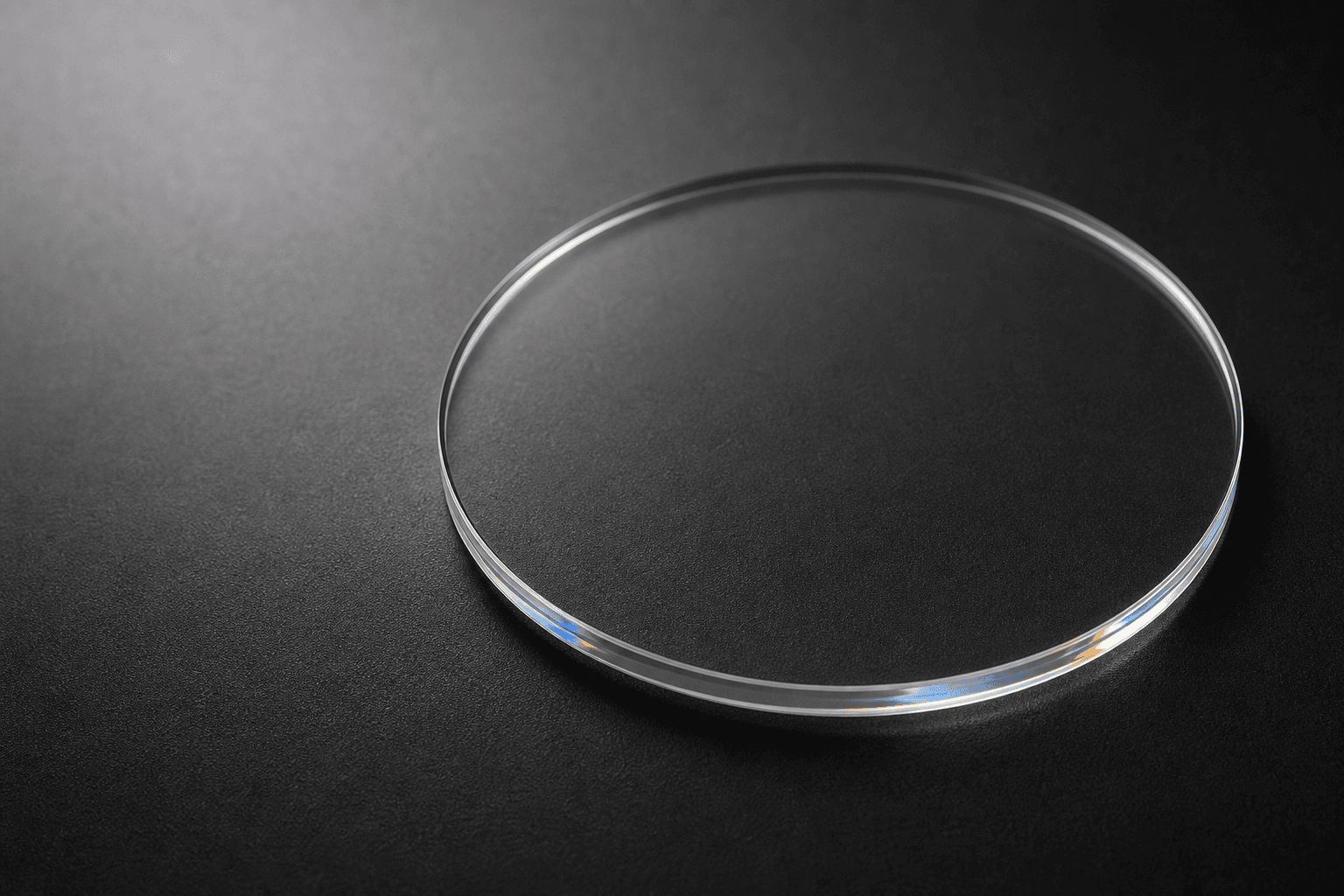
Industry context: CVD diamond heat spreaders are thin synthetic-diamond tiles (often <2 mm, ultra-flat) placed between the heat source and a cooled sink — combining very high thermal conductivity with electrical insulation. Thermal-grade CVD diamond is supplied as transparent polycrystalline discs/wafers; optical-grade material offers higher clarity when transmission matters. Graded products commonly cite ~1,500–2,200 W/m·K depending on grade (Coherent — diamond heat spreaders).
When SiC is still the right answer
Default to SiC when peak power density is below roughly 100–150 W/cm², pulsed lidar margins close in simulation after thickness reduction, or BOM and supply-chain maturity matter more than the last tranche of ΔT. See thermal path design for pulsed lidar — SiC is the standard submount for 905 nm ToF emitters for good reason.
- Automotive and industrial lidar at 905 nm with validated SiC stacks.
- GaN RF modules in the ~10–40 W CW class where SiC spreading is sufficient.
- Programs that can achieve target Tj with thinner SiC or improved die attach void control.
Signals that diamond may be worth scoping
Peak density exhausted SiC
Simulation or IR shows junction overshoot during burst firing after SiC thickness and pad geometry are optimized.
Multi-kW laser bars
CW or quasi-CW bars where facet temperature and smile drive reliability — spreading dominates before sink.
Sub-mm RF hotspots
GaN PA or MMIC channels where gate-finger region ΔT limits linearity or phase noise.
Co-packaged photonics
Tight junction-to-case budget where every °C in the spreader layer counts toward wavelength or SNR margin.
Stack design: diamond is not drop-in
Diamond's CTE (~1.0–1.5 ppm/°C) does not match GaAs, InP, or GaN die directly in a monolithic submount the way ALN and SiC can. Production stacks typically use:
- Diamond tile — CVD film or freestanding spreader for lateral conduction.
- Engineered carrier — SiC, copper, or composite layer to manage CTE and attach.
- Metallization — carbide-forming adhesion on diamond pads; Au/Sn or solder scoped per line.
- Die attach — reflow window validated against void and shear targets.
FerraLink scopes diamond programs through Stack Scoping (material direction and geometry bands) or Focused Analysis (pass/fail vs your ΔT targets with variant comparison) — not through the standard catalog sample box.
Decision flow (simplified)
1. Is power density moderate and CTE match to InP/GaAs primary? → Start with ALN.
2. Is peak density or pulsed transient above ALN margin? → Move to SiC.
3. After SiC geometry optimization, does simulation still fail Tj or hotspot targets? → Scope diamond early access.
4. Is ground current or laminate CTE the limiter instead of ceramic spreading? → Evaluate Cu-Mo-Cu per GaN RF submount guide.
Stack Scoping (T1) or Focused Analysis (T2): Send die size, peak power, and attach constraints — we recommend ALN vs SiC vs diamond tier, carrier stack, and metallization before you freeze the BOM. Expand the technical review for CVD growth, thermal boundary resistance, and device-level validation literature.
For experienced packaging engineers
Literature-backed CVD diamond submount review
Peer-reviewed sources, interface data, and packaged-device literature — written by FerraLink materials engineering to support submount and attach decisions, not as neutral survey copy.
+22 minExpand literature-backed review ↓
For experienced packaging engineers
Literature-backed CVD diamond submount review
Peer-reviewed sources, interface data, and packaged-device literature — written by FerraLink materials engineering to support submount and attach decisions, not as neutral survey copy.
This review supports FerraLink's pre-release diamond submount program — polycrystalline CVD diamond heat spreaders for laser, lidar, and GaN RF stacks when single-crystal SiC spreading is exhausted. We align published thermal conductivity, interface resistance, and packaged-device data with the ALN → SiC → diamond material ladder.
1. Material landscape and thermal hierarchy
Wide-bandgap and ultrawide-bandgap devices push junction power density past what polycrystalline ALN (170–210 W/m·K) and production single-crystal SiC (350–400 W/m·K) can spread in the available footprint. CVD polycrystalline diamond at 1,500–2,200 W/m·K in-plane offers roughly 4–6× SiC lateral spreading — but only when interface thermal resistance (TBR) and attach voids are controlled[Zhan 2023].
Diamond's CTE (~1.0–1.5 ppm/°C) is well matched to some WBG dies but mismatched to typical laser die and carrier metals — production stacks use SiC, copper, or composite carriers rather than bare diamond monoliths[Linhai 2024].
2. CVD growth and substrate integration
Microwave plasma-enhanced CVD (MP-CVD) builds polycrystalline diamond on seed layers; low-nitrogen growth can approach ~1,950 W/m·K on heterogeneous substrates[Linhai 2024]. Heteroepitaxial demonstrations on Si, SiC, and Mo report composite conductivities of 450–500 W/m·K — still below bulk diamond but useful as engineered spreader/carrier hybrids.
Device-level nanocrystalline diamond (NCD) at reduced growth temperature (~400°C) has shown ~42% gate-region thermal resistance reduction on (AlxGa1−x)2O3/Ga2O3 HFETs with SiNx barriers protecting gate oxides from H2 plasma damage[Hannah 2024].
3. Thermal boundary resistance and interlayers
Bulk diamond k is irrelevant if TBR dominates. Record-low diamond/Si3N4/GaN TBR of 3.1 ± 0.7 m²·K/GW was achieved with polycrystalline diamond grown within ~1 nm of the channel and isotropic grain structure (>2 µm thickness, ~1.9 µm lateral grain)[Malakoutian 2021].
Carbide interlayers (Cr/Cr3C2, B4C, WC) strongly affect Cu/diamond and diamond/AlGaN interfaces — optimized annealing can more than double effective composite conductivity versus uncoated copper/diamond specimens[Yajing 2026] [Aller 2024]. AlN seeding on GaN before PCD growth reduced effective TBR versus SiNx approaches (~5 vs ~20 m²·K/GW class)[Sang 2024].
PWA-TDTR and sequential delamination methods now resolve buried interface resistance in thick Au-bonded Si-on-diamond stacks — critical for validating bonding voids and layer-specific k in production assemblies[Zhang 2026] [He 2026].
4. Transient spreading, lidar, and laser bars
Under ultra-high flux, diamond microchannels show several °C lower peak temperature than copper at comparable flow rates[Jiwen 2024]. For GaN HEMTs, adding a ~10 µm PCD layer (k ~1200 W/m·K) reduced peak Tj and thermal crosstalk; replacing the Si substrate with PCD cut ΔTj,max by up to 73% — confirming diamond's role as a spreader, not just a bulk sink[Yussof 2024].
S-band GaN PA demonstrations report 20–30% MMIC temperature reduction with diamond heat spreaders, or 30–100× pulse width extension at the same Tj,limit[van Heijningen 2024]. High-duty-cycle diode laser stack FEA shows quasi-CW pulsed profiles differ materially from steady-state assumptions — improved spreader k directly scales duty cycle when attach resistance is held fixed[Elattar 2024].
5. ALN and SiC as gateway materials
Modern AlN densification and powder engineering hold polycrystalline k in the 170–210 W/m·K band for laser and RF ceramic routes[Du 2026]. GaN-on-SiC reviews emphasize TBR as the bottleneck once bulk SiC k is adequate — the crossover toward diamond typically appears above ~150 W/cm² peak density when geometry optimization on SiC is exhausted[Zhan 2023].
Wafer-scale cubic 3C-SiC can exceed 500 W/m·K at room temperature — still below diamond but relevant when comparing engineered SiC/diamond composite carriers[Cheng 2022].
6. Packaging integration paths
Diamond-on-chip-on-interposer (2.5D) and diamond-on-chip-on-glass (DoCoG) integrations cut junction-to-ambient resistance by 20–28% in reported high-power-density chiplet scenarios using low-temperature Cu/Au bonding and nano-interlayers[Tao 2024] [Zhong 2024].
GaN HEMTs on 4H-SiC/diamond engineered substrates with surface-activated bonding achieved 98% bonding yield and ~40°C lower Tj at 23.4 W/mm versus SiC-only substrates at comparable dissipation[Lei 2026].
7. Reliability, CTE, and cycling
Temperature-dependent TBR in GaN-on-diamond wafers shows interlayer conductivity changes that can mitigate or exacerbate thermal runaway — qualification must include TBR(T), not just room-temperature k[Sun 2016]. Packaging materials with offset CTE fillers reduce interfacial stress in WBG modules under power cycling[Li 2025].
8. Decision matrix (FerraLink ladder)
| Criterion | SiC (production) | CVD diamond (pre-release) |
|---|---|---|
| k in-plane (W/m·K) | 350–400 | 1,500–2,200 |
| Peak power density | < ~150 W/cm² typical | > ~150 W/cm² after SiC opt. |
| CTE (ppm/°C) | 3.7–4.3 | ~1.0–1.5 (needs carrier) |
| Electrical | Semi-insulating | Insulating spreader |
| Attach maturity | Catalog AuSn/TiPtAu | Scoped per program |
| Sample path | Standard sample box | Early access only |
9. How FerraLink applies this
- Default production path: ALN or SiC submounts with documented k and metallization.
- When SiC FEA/bench still fails margin, scope diamond early access — not before attach and geometry are optimized.
- Pair diamond interest with Stack Scoping or Focused Analysis; characterize TBR and voids before build slots.
- Cross-check header/TIM path via pulsed thermal and duty-cycle guides.
References
A. M. Yussof et al. (2024). Heat spreader effectiveness in GaN HEMT co-simulation. IEEE ICSE. DOI
H. Aller et al. (2024). Low thermal resistance diamond–AlGaN interfaces via carbide interlayers. Adv. Mater. Interfaces. DOI
H. N. Masten et al. (2024). NCD-capped Ga2O3 HFET thermal reduction. Appl. Phys. Lett.. DOI
H. Sun et al. (2016). Temperature-dependent TBR of GaN-on-diamond HEMT wafers. IEEE EDL. DOI
J. Zhao et al. (2024). Diamond microchannel heat dissipation under high flux. Processes. DOI
L. Sang et al. (2024). AlN interlayer for GaN-to-CVD-diamond thermal path. Inf. Funct. Mater.. DOI
L. Guo et al. (2024). CVD diamond growth on Si, SiC, Mo for heat spreaders. ECS Meeting Abstracts. DOI
M. Malakoutian et al. (2021). Record-low TBR between diamond and GaN-on-SiC. ACS Appl. Mater. Interfaces. DOI
M. van Heijningen et al. (2024). CVD diamond spreaders on 400 W S-band GaN PA MMIC. EuMC. DOI
M. Elattar et al. (2024). FEA of high-power diode laser stacks for high-duty-cycle pumps. IEEE JSTQE. DOI
M. Zhang et al. (2026). Buried-interface TDTR with periodic waveform analysis. Mater. Today Phys.. DOI
P. Du et al. (2026). AlN synthesis and densification review. J. Am. Ceram. Soc.. DOI
T. Zhan et al. (2023). TBR effects in GaN thermal management — review. Micromachines. DOI
Y. Liu et al. (2026). Annealing effects on Cu/Cr-coated diamond composites. Materials. DOI
Y. He et al. (2026). Deeply buried thermal resistance in Au-bonded Si-on-diamond. Appl. Phys. Lett.. DOI
Y. Zhong et al. (2024). Diamond-on-chip-on-glass interposer thermal management. IEEE EDL. DOI
Y. Lei et al. (2026). GaN HEMTs on 4H-SiC/diamond engineered substrate. IEEE EDL. DOI
Y. Li et al. (2025). CTE-offset epoxy for power semiconductor cooling. Adv. Funct. Mater.. DOI
Z. Tao et al. (2024). Diamond-on-chip-on-interposer for 2.5D chiplets. ICEPT. DOI
Z. Cheng et al. (2022). High thermal conductivity wafer-scale cubic SiC. Nat. Commun.. DOI
FerraLink selects citations for packaging relevance; verify against your program requirements before qualification sign-off.
Related articles
Pre-release program
Request diamond submount early access
Evaluation partnerships only — we assess stack fit and reply with scoped engineering path.
Early access form →
The part that depends on your die
The rules above hold for most edge-emitter modules. What changes from program to program is geometry, duty cycle, and how hard you are pushing junction temperature — those inputs decide material, thickness, and whether catalog samples are enough.
- Peak and average power density (W/cm²), duty cycle, and target junction or case ΔT.
- Whether SiC geometry and thickness were already optimized in simulation.
- Carrier stack concept (diamond-on-SiC vs standalone tile) and attach line constraints.
Go deeper — Pick material
These guides answer adjacent questions teams ask while choosing a submount. Each ends the same way: what you can decide in general, then what needs your die and power.
- ALN vs SiC Submounts: Thermal Conductivity, CTE, and Cost Comparison12 min · Use polycrystalline ALN (170–210 W/m·K) below ~100 W/cm² for InP/GaAs CTE match; choose single-cryst…
- DPC vs AMB vs DCB on Laser Submounts: Metallization Process Guide10 min · When to use direct plated copper (DPC), active metal brazing (AMB), or direct copper bonding (DCB) o…
- Single-Crystal SiC vs Polycrystalline ALN: A Microstructure Explanation5 min · Why single-crystal SiC reaches 350–400 W/m·K while polycrystalline ALN stops at 170–210 W/m·K — phon…
- GaN RF Power Module Submount Selection: SiC vs ALN vs Cu-Mo-Cu6 min · Submount material selection for GaN HEMT and MMIC power modules — thermal conductivity, CTE match, c…
More topics coming — thermal path, attach yield, qualification, and packaging context.