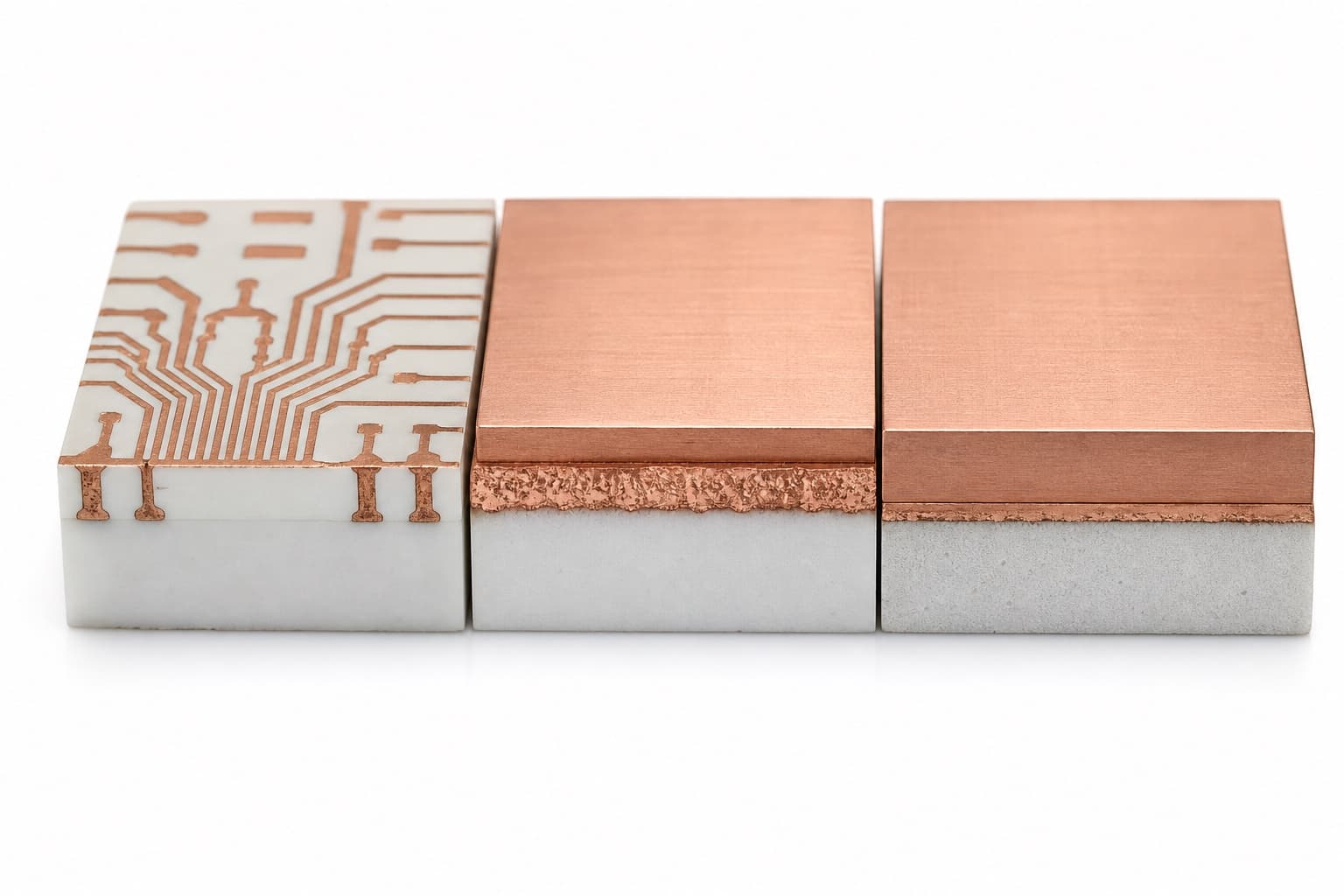
Three ways copper meets ceramic
Laser submounts need copper for die pads, wire bonds, and in-plane heat spreading — bonded to ALN or SiC. The manufacturing route sets minimum line width, achievable copper thickness, residual stress, and fatigue life under thermal cycling. FerraLink catalog photonic tiles are overwhelmingly DPC; AMB and DCB enter when current density or module outline looks more like power electronics than a 3 mm laser tile.
Related: what is a laser submount · GaN RF submount selection · AuSn pre-deposited pads on DPC.
Process comparison
| Process | How it works | Best for | Typical line/space |
|---|---|---|---|
| DPC — Direct Plated Copper | Sputter seed + electroplated Cu | Laser submounts, photonic pads | ≥ 50 µm |
| AMB — Active Metal Brazing | Braze thick Cu foil (Ag-Cu-Ti) | High current, power modules | ≥ 100–200 µm |
| DCB — Direct Copper Bonding | Eutectic Cu–ceramic bond | Large power substrates | Coarse patterns |
| HTCC (related) | Co-fired W/Mo in ceramic | Hermetic multi-pin housings | Not submount tiles |
Performance snapshot (literature bands)
| Parameter | DPC | AMB | DCB |
|---|---|---|---|
| Cu thickness | 25–150 µm | 150–500 µm | 200–600 µm |
| Line/space | ≥ 50 µm (finer in lead fabs) | ≥ 100–200 µm | ≥ 100–200 µm |
| Thermal cycling (severe ΔT) | > 1000 cycles* | 500–1500 cycles* | 100–500 cycles* |
| Residual warpage (50 mm tile) | < 50 µm typical | 100–300 µm | 50–150 µm |
*Highly ceramic-dependent; Si₃N₄ AMB outperforms Al₂O₃ in published thermal shock studies.
Decision guide for laser teams
- Edge-emitter DFB / EML on 3–5 mm submount: DPC on ALN or SiC + selective AuSn pre-deposit.
- Multi-watt bar or pump on spreading tile: DPC on SiC; verify Cu thickness for stripe current.
- GaN RF in hermetic box: Often AMB base module + DPC photonic submount inside — see GaN RF guide.
- Large-area cost-driven power tile: DCB on alumina — outside typical laser submount catalog geometry.
What you can decide here
- Which process family matches your line width, copper thickness, and current.
- Why fine-pitch laser submounts standardize on DPC rather than brazed foil.
- When to escalate from catalog DPC to custom AMB for module-level substrates.
What still needs your drawing
- Copper thickness map, pad stack, and AuSn vs wire-bond pad keep-out.
- Target thermal cycling and whether Si₃N₄ vs ALN is mandated by your module spec.
- Assembly house capability (DPC lithography vs AMB brazing line).
Specifying a custom build? Expand the technical review below — CTE mismatch mechanics, DPC plating stress, AMB warpage, failure analysis methods, and literature we reference in Stack Scoping for non-catalog metallization.
For experienced packaging engineers
Literature-backed metallization review
Peer-reviewed sources, interface data, and packaged-device literature — written by FerraLink materials engineering to support submount and attach decisions, not as neutral survey copy.
+24 minExpand literature-backed review ↓
For experienced packaging engineers
Literature-backed metallization review
Peer-reviewed sources, interface data, and packaged-device literature — written by FerraLink materials engineering to support submount and attach decisions, not as neutral survey copy.
FerraLink publishes this section for materials and packaging engineers evaluating copper–ceramic build routes for photonic and RF tiles. We synthesize peer-reviewed work on DPC, AMB, and DCB — emphasizing thermomechanical reliability, not a generic materials survey — and state where our catalog DPC AlN/SiC line fits.
1. Ceramic platforms and CTE mismatch
ALN remains the default high-k ceramic for laser submounts (170–230 W/m·K class bulk k). Si₃N₄ offers higher fracture toughness and competitive thermal performance in power-module literature, with advantages under aggressive thermal cycling (−40°C to 250°C class)[Yue 2022] [Shi 2020].
Copper metallization (CTE ~16–17 ppm/K) on ALN (~4–5 ppm/K) generates tensile stress at the interface that scales with temperature swing. FEA work on Al₂O₃, ALN, and Si₃N₄ substrates under thermal shock quantifies interfacial tensile stress exceeding 150–200 MPa in poorly optimized stacks[Shi 2020]. Dong et al. modeled AMB substrate warpage during cool-down from brazing temperature — residual bow on 50×50 mm tiles can reach 100–300 µm, persisting into assembly and thermal cycling[Dong 2024].
2. DPC: process, pattern fidelity, and failure modes
DPC is the dominant route for edge-emitting laser submounts: clean ceramic, sputtered Ti/Ni or Ti seed, photolithography, and electroplated copper to target thickness (often 25–150 µm on photonic pads)[Shen 2024]. Shen et al. report DPC ceramic sub-mount builds specifically for high-power edge-emitting laser applications at IMPACT 2024 — aligned with FerraLink’s DPC tile product direction.
Seed-layer chemistry controls adhesion. Chen et al. developed thin-film metallization on Si₃N₄ for power packaging, emphasizing Ti-based transition layers and surface prep for atomic-scale bonding at the ceramic interface[Chen 2023]. Zhao et al. targeted low residual stress in three-dimensional DPC structures — plating current density, anneal (150–300°C), and pattern geometry drive 20–80 MPa tensile stress in struts with concentration at pattern corners[Zhao 2022].
Wang et al. studied DPC bonding strength and tensile failure — well-optimized interfaces exceed ~100 MPa shear in single-shear tests, but failure analysis often shows crack initiation in the ceramic subsurface 20–100 µm below the interface, not at the copper bond line itself[Wang 2022]. Design implication: beyond ~80 MPa interfacial shear, reliability levers shift to copper stress relief (anneal, patterned breaks) rather than incremental adhesion alone.
Optimized DPC with patterned copper (avoiding large unbroken Cu islands) has demonstrated more than 1000 thermal cycles in published −40°C to 250°C class testing; large uniform copper regions and plating thickness non-uniformity degrade cycle life[Zhao 2022].
3. AMB: brazing chemistry, warpage, and ceramic choice
AMB bonds pre-oxidized copper foil with active filler (Ag-Cu-Ti class, 850–1050°C brazing). Ti reacts with oxide species on the ceramic to form a metallurgical reaction layer — without active metal, shear strength stays in the ~10–20 MPa mechanical-interlock range[Shin 2018] [Kim 2023].
Kim et al. characterized solder and sinter joints on AMB with nano sputtered Ag-Cu-Ti filler, reporting peel strengths in the 1.5–4.5 kgf/mm band depending on ceramic and brazing parameters — substantially above typical DPC peel in comparable tests[Kim 2023].
Choe et al. compared thermal shock performance of DBA/AMB substrates with Ni and Ni–P plating on the copper face. Si₃N₄-based AMB survived more than 1000 shock cycles where Al₂O₃ failed within tens to hundreds of cycles; failure mode shifted from bulk ceramic fracture to interfacial damage on tougher ceramics[Choe 2018]. Ni-P plating introduced cracking under cycling — relevant when specifying finish on AMB power tiles.
4. DCB and when it leaves the laser submount domain
DCB eutectically bonds thick copper (200–600 µm) to ceramic, historically alumina, at ~1050–1100°C. It is cost-efficient for large-area power modules but coarse in pattern resolution (≥ 100 µm class) and weaker on non-alumina ceramics compared to DPC on ALN/SiC photonic geometries[Shi 2020].
For 3–5 mm laser submounts requiring 50 µm pad definition and selective AuSn, DCB is rarely competitive. It remains in the decision tree for hybrid systems where a DPC photonic tile mounts onto a DCB power spreader in the package — not as a replacement for the tile metallization itself.
5. Reliability testing and failure analysis
Standard qualification uses accelerated thermal cycling (−40°C to +125°C or wider). Lee et al. integrated manufacturing process variables with thermal cycling load in power-module FEA — cycle-to-failure kinetics follow Coffin-Manson-like scaling with ΔT exponent ~2–4 depending on material system[Lee 2024].
Ngo et al. applied digital image correlation (DIC) to metallized Si₃N₄ during live cycling — strain ratcheting and 2–3× higher strain at pattern edges explain clustered crack initiation at geometry discontinuities[Ngo 2025]. Schmid et al. (Part II) document failure-analysis methodology: serial cross-section, SEM/EDS, XCT, and SAM for delamination detection in automotive-class solder interconnects[Schmid 2023].
George et al. analyzed nonconchoidal fracture from delamination in power-electronics baseplate solder joints — relevant when DPC/AMB tiles are soldered into larger copper spreaders and interface defects propagate upward[George 2018].
6. Photonic submount thermal layout
Edge-emitting DFB/EML modules target low junction-to-case R on small footprints. Marinins et al. demonstrated wafer-scale flip-chip bonding of InP DFB lasers to Si photonics with sub-300 nm alignment — assembly constraints on submount planarity and pad coplanarity carry directly to DPC tile spec[Marinins 2022].
Selective thick-copper regions under the stripe (100–200 µm) vs fine-pitch bond pads (~50 µm) create plating current-density variation unless anode and masking are engineered — Zhao et al. report ±20% thickness variation across features without adaptive plating control[Zhao 2022]. FerraLink DPC builds separate die pad, wire bond, and optical keep-out regions in one lithography flow for this reason.
7. Emerging routes (context for RFQ discussions)
Quasi-direct Cu–Si₃N₄ bonding with multi-layer active metal deposition targets AMB-class strength at lower peak temperature (~600–700°C), reducing residual stress vs conventional brazing[Tatsumi 2024]. Ferguson et al. report Cu/Zr interlayers improving thermal fatigue life on DBC-style structures by buffering CTE mismatch[Ferguson 2025]. These are not catalog laser submount processes today but inform custom module RFQs.
8. Application selection matrix
| Application | Recommended build | Critical parameter |
|---|---|---|
| DFB / EML / tunable laser tile | DPC on ALN or SiC | Pattern stress relief; AuSn pad spec |
| GaN / SiC RF power module | AMB on Si₃N₄ | Warpage; Ni finish choice |
| Large-area power substrate | DCB on Al₂O₃ | Solder joint stress at tile edge |
| 250°C+ sustained environment | AMB / emerging QDC | High-T attach + long-cycle data |
9. How FerraLink applies this
- Standard laser submounts: DPC on ALN/SiC with Ti/Pt/Au or Ti/Ni/Au and optional pre-deposited AuSn — optimized for fine pitch and attach yield.
- Custom AMB/DCB: RFQ with current map, cycling requirement, and outline; we align ceramic grade (ALN vs Si₃N₄ vs SiC) to your ΔT profile.
- Qualification support: reference Shen/Zhao/Wang DPC laser-submount and cycling literature when customers audit our process rationale.
- Stack Scoping (T1): when a module mixes DPC photonic tile + AMB power floor, we document thermal and stress interfaces together — not tile metallization in isolation.
References
E. Shen et al. (2024). High power laser sub-mount of DPC ceramic for edge emitting laser applications. IMPACT. DOI
H. Zhao et al. (2022). Low residual stress three-dimensional direct plated copper ceramic substrate. ICEPT. DOI
Y. Wang et al. (2022). Bonding strength test and tensile failure study for DPC ceramic substrate. ICEPT. DOI
X. Chen et al. (2023). Thin film metallization process development for Si₃N₄ ceramic substrates. ICEPT. DOI
D. Hu et al. (2024). Warpage deformation analysis of AMB ceramic substrates in power modules. EuroSimE. DOI
M.-S. Kim et al. (2023). Bonding characteristics on AMB with nano sputtered Ag-Cu-Ti filler. J. Welding Joining. DOI
J.-H. Shin et al. (2018). Active metal brazed joint of Al₂O₃/Cu for EV power modules. EHST. DOI
C. Choe et al. (2018). Thermal shock performance of DBA/AMB substrates with Ni and Ni–P plating. Materials. DOI
Y. Shi et al. (2020). FEA fracture mechanics of Al₂O₃, AlN and Si₃N₄ substrates under thermal shock. ICEPT. DOI
Y. Yue et al. (2022). Effect of sintering process on mechanical properties of silicon nitride. ICEPT. DOI
C.-C. Lee et al. (2024). Manufacturing process integrated with thermal cycling on power module mechanics. IEEE TCPMT. DOI
M. C. Ngo et al. (2025). Degradation of metallized Si₃N₄ under thermal cycling (DIC). J. Compos. Sci.. DOI
M. Schmid et al. (2023). High-power LEDs and solder interconnects — Part II reliability. IEEE TDMR. DOI
A. George et al. (2018). Nonconchoidal fracture from delamination in power electronics substrates. ESTC. DOI
A. Marinins et al. (2022). Wafer-scale hybrid integration of InP DFB lasers on Si photonics. IEEE JSTQE. DOI
H. Tatsumi et al. (2024). Quasi-direct Cu–Si₃N₄ bonding with multi-layer active metal deposition. Mater. Des.. DOI
J. B. Ferguson et al. (2025). Cu/Zr alloy interface for enhanced thermal fatigue in electronic packaging. ACS Omega. DOI
FerraLink selects citations for packaging relevance; verify against your program requirements before qualification sign-off.
The part that depends on your die
The rules above hold for most edge-emitter modules. What changes from program to program is geometry, duty cycle, and how hard you are pushing junction temperature — those inputs decide material, thickness, and whether catalog samples are enough.
- Required copper thickness, line/space, and current per pad on your drawing.
- Thermal cycling profile and pass/fail criterion (cycles, ΔT, delamination).
- Whether your assembly house is qualified on DPC photolithography vs brazed foil builds.
Go deeper — Pick material
These guides answer adjacent questions teams ask while choosing a submount. Each ends the same way: what you can decide in general, then what needs your die and power.
- ALN vs SiC Submounts: Thermal Conductivity, CTE, and Cost Comparison12 min · Use polycrystalline ALN (170–210 W/m·K) below ~100 W/cm² for InP/GaAs CTE match; choose single-cryst…
- Single-Crystal SiC vs Polycrystalline ALN: A Microstructure Explanation5 min · Why single-crystal SiC reaches 350–400 W/m·K while polycrystalline ALN stops at 170–210 W/m·K — phon…
- GaN RF Power Module Submount Selection: SiC vs ALN vs Cu-Mo-Cu6 min · Submount material selection for GaN HEMT and MMIC power modules — thermal conductivity, CTE match, c…
More topics coming — thermal path, attach yield, qualification, and packaging context.