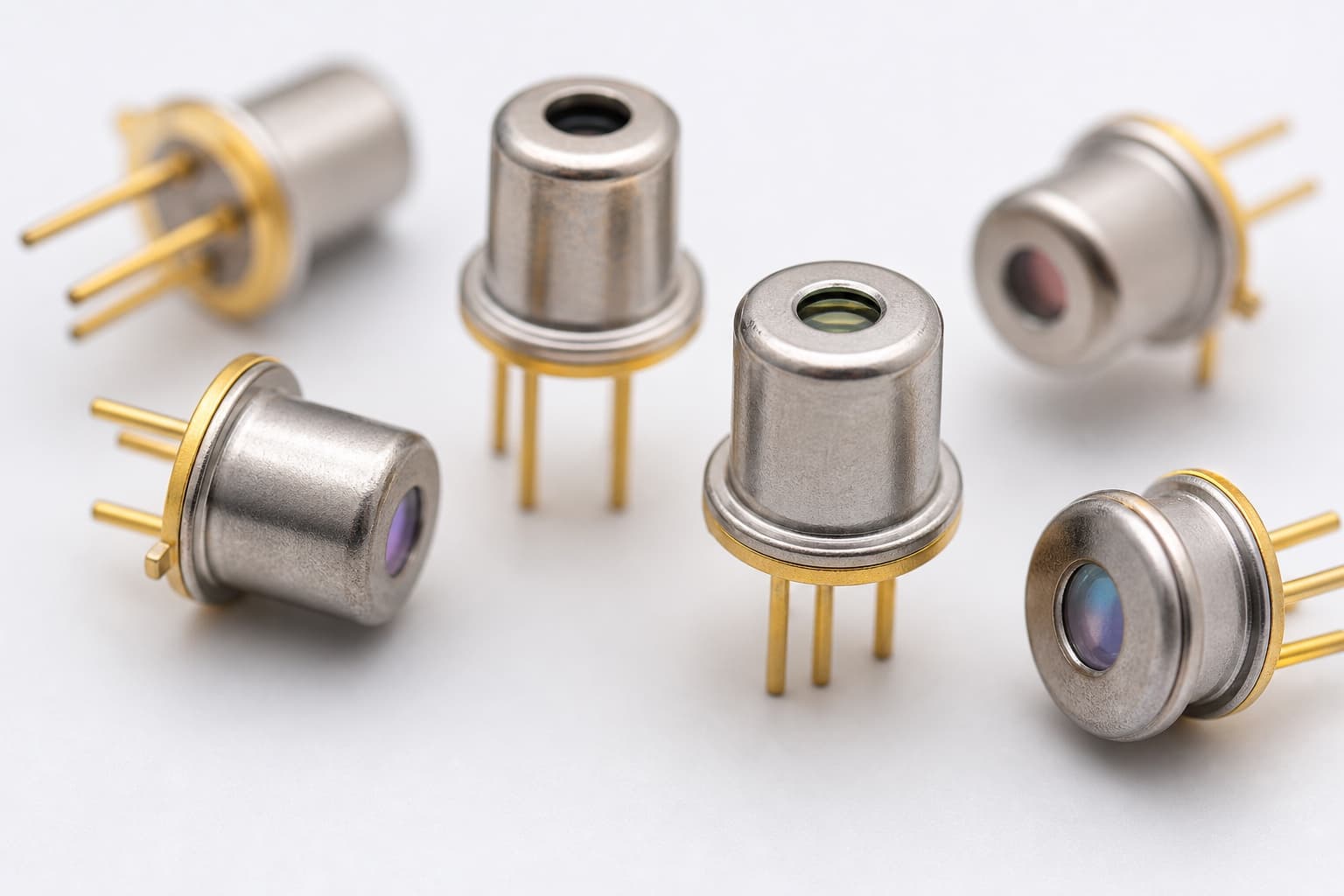
What a TO-46 package does
A TO-46 package is a hermetic metal can that holds a small laser diode or VCSEL. Glass-to-metal pins bring power and signal out through the base, and a window or lens in the cap lets the light out. The base is about 4.7 mm, which is why it shows up in space-tight sensing and time-of-flight modules.
- Hermetic housing. The cap and glass seals keep the chip in a controlled atmosphere.
- Optical exit. A flat window, an AR-coated window, or a lens sets how the beam leaves the can.
- Compact emitter. The 4.7 mm base fits VCSEL arrays and short-reach sensing. Lead length and the small aperture limit it to about 2 Gbit/s.
TO-46 next to the other headers
| Package | Base | Speed class | Primary use |
|---|---|---|---|
| TO-46 | 4.7 mm | Up to about 2 Gbit/s | VCSEL, time-of-flight, compact sensing |
| TO-18 | 5.6 mm | Up to 2.5 Gbit/s | DFB, FP, pumps, industrial CW |
| TO-56 | 5.6 mm | About 10 Gbit/s | SFP-class lasers, monitor photodiode |
| TO-60 | 5.6 mm class | 25 Gbit/s class | EML and coherent TOSA |
The full comparison, including detector cans such as TO-5 and TO-8, is the TO header selection guide. A fiber-pigtailed DFB that needs TEC pins is a 14-pin butterfly package, not a TO-46.
What sits inside the can
The chip usually sits on a submount, not directly on the header post. An AlN submount is the common choice for a CW VCSEL or sensing laser. A SiC submount is the step up when the pulse current needs more spreading. Junction-to-case thermal resistance on a small can is often in the 200–300 K/W class, which is acceptable for sub-watt CW and tight for a high-duty pulse.
Catalog outlines and the quote form are on the TO header page. A drawing review goes through the TO header RFQ. Quotes typically return in 2–4 weeks.
The part that depends on your die
The rules above hold for most edge-emitter modules. What changes from program to program is geometry, duty cycle, and how hard you are pushing junction temperature — those inputs decide material, thickness, and whether catalog samples are enough.
- Module outline, leak rate, and window transmission for your wavelength.
- TEC vs uncooled budget for your channel plan.
- Submount choice inside the full hermetic stack.
Go deeper — Package context
These guides answer adjacent questions teams ask while choosing a submount. Each ends the same way: what you can decide in general, then what needs your die and power.
- TO18, TO46, TO56, TO60: Which Laser Diode Header for Your Application?12 min · The complete TO package selection guide — transmitter vs detector cans, data-rate limits, optical wi…
- Optical Window Selection for Hermetic Laser Packages10 min · Sapphire, borosilicate, and AR-coated windows for TO and butterfly hermetic packages — wavelength, t…
- Hermetic Packaging for LiDAR Applications7 min · Package types, thermal management, optical window selection, and reliability requirements for lidar …
- Thermal Path Design for Pulsed LiDAR Emitters: Junction to Heat Sink6 min · Pulsed 905 nm lidar emitters need heat to spread through the submount faster than the pulse duration…
More topics coming — thermal path, attach yield, qualification, and packaging context.